Charlotte's housing market is not crashing and it is not booming. It is settling into a new normal built on interest rates in the low sixes, tighter inventory than most buyers expect, and hidden pockets of value just outside the city limits.
On this episode of Make Yourself at Home, I sat down with Charlotte native and real estate broker Scott Byerly of RE/MAX Executive to talk through two decades of market cycles, where the smart money is moving, and why he still believes relationships close more deals than data ever will.
Curious what's really happening in the Charlotte NC real estate market 2026? Watch the short preview clip from this conversation before you read on:
Why I Brought a Red Cross Veteran Turned Charlotte Broker Onto the Show
Before selling houses, Scott worked for 21 years with the American Red Cross, advancing from distribution to managing around 300 hospital contracts in North and South Carolina. He provided support to local blood banks rather than being on disaster sites.
That kind of responsibility teaches a person how to stay calm when something urgent lands on their desk, and it is exactly why I wanted Scott Byerly of RE/MAX Executive on the show.
In 2005, Scott's friend encouraged him to take a real estate course, and he passed the state exam on the first try. He didn’t stop there; he earned degrees in sports medicine and healthcare administration, continually pursuing real estate designations, as learning is in his nature.
That kind of layered education matters more than people realize in a profession where, according to the U.S. Bureau of Labor Statistics, real estate brokers and sales agents only need a high school diploma to get licensed. Scott chose to go far beyond the minimum.
Watch the full episode here:
What carried over from Red Cross was not paperwork. It was the belief that even the biggest purchase of someone's life is not life and death, and that everything is figureoutable if you stay calm and keep working the problem. Scott leans on that mindset constantly with buyers and sellers who are anxious about the largest financial decision they will ever make. You can see the same steady, relationship-first approach reflected in his current Charlotte and Harrisburg area listings.
What Two Decades of Charlotte Market Cycles Taught Scott Byerly
When asked about significant shifts in Charlotte's real estate over the past twenty years, Scott highlights the 2008 bank-driven crash due to lax lending. Following that, COVID caused a sudden inventory drop, leading to a 15-20% appreciation in home values across the area.
Buyers waived inspections and appraisals just to compete, and Scott says he is still seeing the buyer's remorse from those decisions play out today. The Charlotte housing market interest rates were such that money was essentially free to borrow at rates near two and three-quarters percent, and Scott is blunt that it was an artificial economy most of us will never see again in our lifetime.
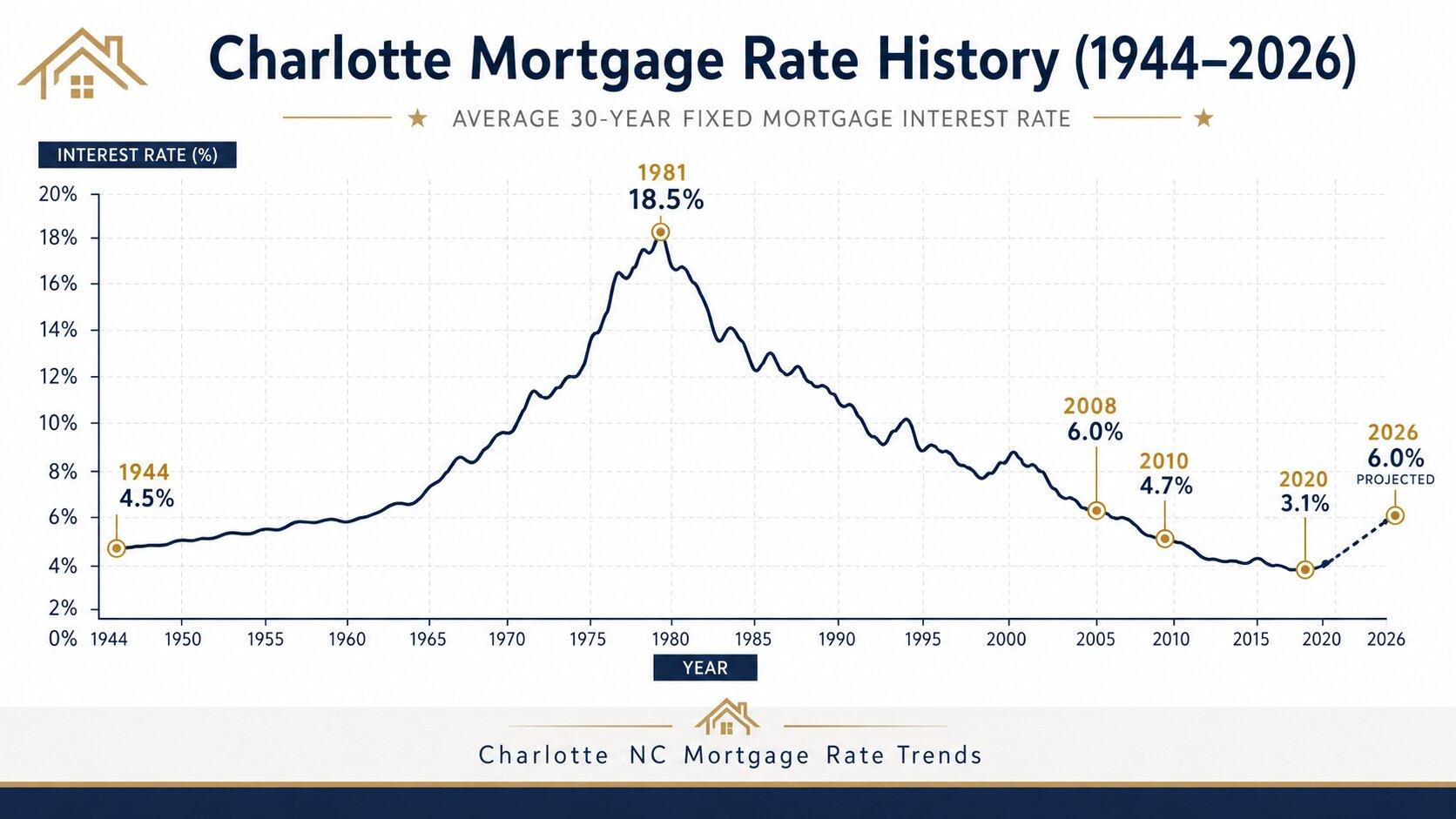
I get the same question from clients every week. When are we getting back to three percent? Scott has a funny way of putting that in perspective. Rates first touched three percent back in 1944, and did not get there again until 2010. That is seventy years apart, so his honest guess for the next time is somewhere around 2080 or 2090. It sounds like a joke until you realize he means it.
Rates sitting around 6.4 percent are not high by any historical measure. They are simply normal, and lenders watching the bond index locally were even predicting we would dip below six percent by the end of the year before unrest in the Middle East pushed those projections back. Scott still thinks 5.75 percent was within reach, and for anyone who bought at seven percent in the last couple of years, that gap represents a real refinance opportunity worth watching closely.
The Hidden Charlotte Suburbs Where Long-Term Value Still Hides
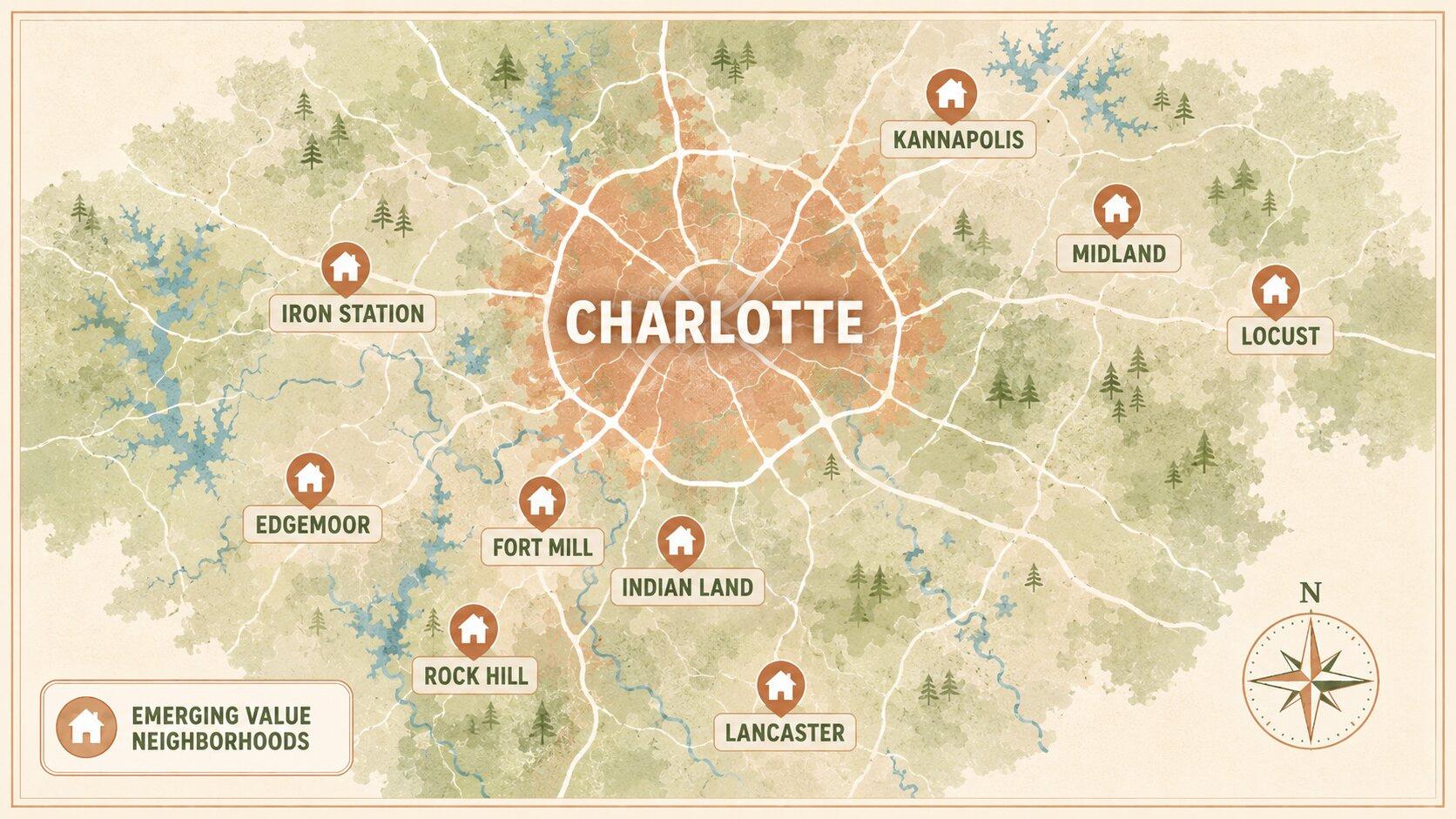
When I asked Scott about hidden value, he was quick to respond. Development is picking up along the 24/27 corridor toward Midland and Locust, with builders like KB Homes returning. Indian Land has new construction too, though Lancaster County is trying to slow growth due to strained services.
Scott also mentioned Mint Hill along Highway 218, and York, South Carolina, where he helped a family from New Jersey find an affordable home. Curious about Charlotte North Carolina home buying tips? Check these valuable insights for Charlotte home buyers.
The math behind all of this growth is stark. According to historical housing starts data tracked by the Federal Reserve Bank of St. Louis, new home construction fell sharply after 2008 and stayed depressed for years, which lines up exactly with what Scott has watched happen on the ground in Charlotte.
"We lost, coast to coast, roughly 10 million new construction homes. From 2008 to about 2018, the U.S. was building about one million fewer homes per year than normal, so over a decade we ended up millions of homes short. Here in the Charlotte area, we need tens of thousands of listings just to serve local demand, and we continue to see strong population growth because the region is still relatively affordable. Some of the more affordable pockets we're watching right now include Rock Hill, Edgemoor, Iron Station, Lancaster, Locust, Midland, and Kannapolis. Kannapolis, in particular, is really starting to catch up with Concord, with a baseball stadium and increasing walkability to stores and restaurants downtown."
– Scott Byerly, RE/MAX Executive
Scott compares Charlotte to lungs: higher gas prices bring people closer, while lower prices cause them to spread out. Remote work changed this, with buyers now considering areas like Albemarle, Clover, Kings Mountain, and even lesser-known towns like Red Cross. Hidden Charlotte growth neighborhoods are becoming increasingly attractive to these buyers.
How Negotiation Strategy Changes Between Luxury Buyers and First-Time Buyers
Every buyer has a pain point, and Scott says finding it is the real job. It might be a relocation for work, a growing family, or simply outgrowing a starter home, but that pain point is also the motivation that shapes every negotiation from there. How Scott approaches that negotiation depends heavily on who is sitting across from him.
Luxury clients are frequently paying cash, which strips out most of the financing contingencies that slow down a typical deal. First-time buyers need a completely different conversation, one built around budget sensitivity rather than sticker price.
"I think the biggest difference is that many of the luxury clients I've worked with are paying cash. They have the funds to buy these homes outright, which eliminates a lot of financing concerns and reduces contingency-related negotiations. With entry-level buyers, you have to be much more aware of budget sensitivity and structure negotiations differently. I'll often explain, 'Instead of asking for a $10,000 price reduction that might only save you about $60 a month, why not negotiate a 2-1 buydown with the lender? That could save you around $400 a month the first year and $200 a month the second year, giving you time to refinance if rates improve.' Many buyers automatically ask for a lower price, but that's not always the best strategy. On luxury properties, you also have more flexibility to negotiate valuable extras. If it's a lakefront home, you might offer full price but ask for the boat, jet skis, kayaks, or outdoor furniture—and many times, you can get them included."
– Scott Byerly
I observed a similar situation with my son and his girlfriend, who wanted to use their down payment to pay off their mortgage. I explained that extra payments only slightly reduce monthly payments, but saving and making one extra annual principal payment can shorten the loan term and reduce total interest. Seeing the numbers side by side changed their perspective on closing.
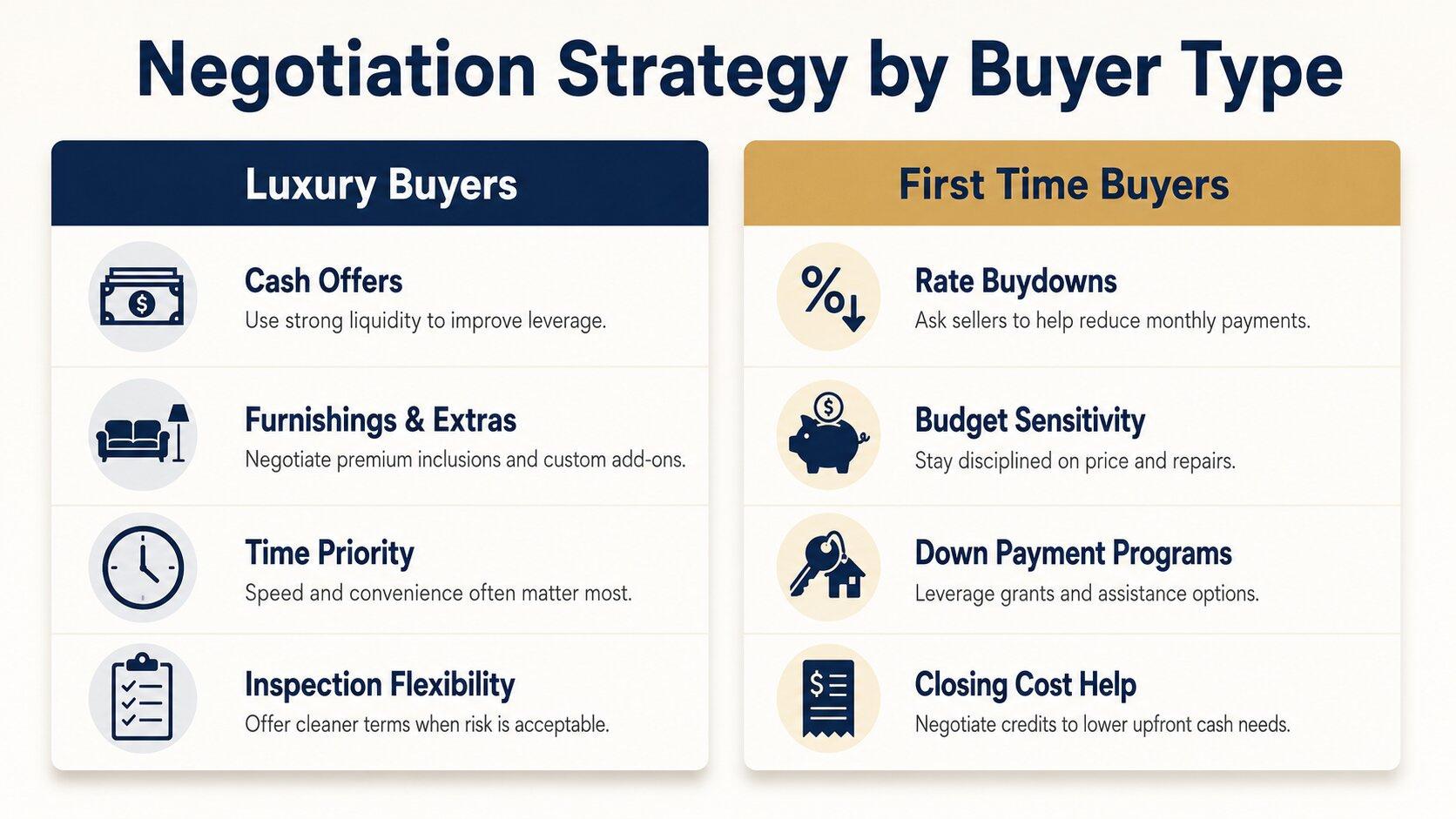
Luxury clients prioritize time over money, as they cannot buy back lost time. Thus, discussions before making an offer must include the full cost of ownership beyond just the mortgage payment. This encompasses negotiable items like homeowners insurance, HOA dues, property taxes, due diligence fees, and earnest money, which first-time buyers often overlook.
Our own step-by-step guide for first-time buyers walks through exactly this kind of budgeting before you ever start touring homes, and it is the same conversation I encourage every client to have before they fall in love with a listing.
That kind of upfront honesty is also why I trust the agents I recommend to clients outside our own coverage area. When I spoke with Alex Mayer about choosing a real estate agent without regret, he made a similar point. The agent who shows up for your first conversation should be the same one representing you all the way to closing.
Why Relationships Still Beat Data When Closing a Deal
Relationship first is not just a phrase for Scott. It shows up in a weekly rhythm he built specifically so no client ever feels forgotten.
"One of the things I started doing a couple of years ago was setting a consistent communication schedule. I tell my clients, 'We'll talk as many times as you want if it makes you comfortable.' But I also let them know that we'll have a dedicated weekly check-in. For my sellers, Tuesday nights are update nights. We talk about everything that happened over the weekend. Buyers are on Wednesdays, when we discuss the homes we toured, what stood out, and what they're thinking moving forward. That way I'm staying in touch every week, nobody feels forgotten, and they also know they can call me anytime."
– Scott Byerly
Scott shared an experience with a young buyer who hesitated to reach out due to fear of being a bother. He emphasized the importance of communication, stating it's the main reason deals fail, not market conditions. Scott asks clients their preferred communication method—text or phone call—and adapts his approach to fit their personality, whether light-hearted or detail-oriented.
I do the same thing with my own audience between episodes, checking in regularly on Instagram so nobody feels like they are just a name on a list. Scott mirrors that same accessibility with his own clients, and it is honestly the biggest reason his business runs on referrals rather than cold leads.
What This Conversation Changed About How I Talk to Buyers About Affordability
The biggest misconception Scott runs into is simple. Buyers think they need twenty percent down, and that belief alone keeps good people renting far longer than they need to.
"A lot of buyers listen to too much news and social media, and that's one of the biggest challenges. They don't realize there are programs available to help them, and they often assume they need a 20% down payment. In reality, there are loan options that require as little as 3.5% down, and there are even down payment assistance programs that can significantly reduce or eliminate the upfront cost. North Carolina and South Carolina both offer a variety of programs to help qualified buyers, but many people simply don't know they exist."
– Scott Byerly
Canopy MLS actually has a built-in icon showing down payment assistance programs in North Carolina. It has a specific property qualifies for, yet most buyers never click it because they assume they already know the answer. If you want to see the range of programs available before you even talk to a lender, the CFPB's guide to finding down payment money is a solid place to start.
I now walk every buyer through page three of a closing disclosure before we go much further, because that is where the real math lives. On a four hundred thousand dollar home, the bank can end up making nearly four hundred thousand dollars in interest over the life of the loan. Scott put it plainly.
You are essentially renting the bank's money, so your job is to get the best possible deal on that rental. Part of the problem is that nobody teaches this in school. Scott and I have both complained about the fact that K through 12 never covers basic financial literacy, and it shows in how intimidated so many buyers feel walking into a lender's office for the first time.
If you want a deeper breakdown of how first-time buyers can use these exact programs to start building wealth instead of paying rent, my conversation on real estate wealth building through low down payment strategies covers that in even more detail, and it pairs perfectly with everything Scott shared.
What Sellers Get Wrong About Pricing in Today's Market
Sellers often make mistakes, especially with curb appeal—landscaping, fresh paint, and repairs are essential. In Charlotte, the 3.2-month housing inventory suggests a "faux balanced market" due to rising rates affecting buyers. Today's buyers want move-in-ready homes, unlike the renovation-focused buyers of 2008.
Scott notes pricing errors, advising sellers to consider current competition instead of outdated comps. If similar homes are listed, being chosen is less likely. He shares an example of a seller who, after highlighting a 1995 design, needed updates after listing with multiple agents.
Scott's biggest red flag is neglect—homes untouched since purchase. He’s straightforward about this because false hope on pricing complicates the process. If you are getting ready to list and want the same step-by-step preparation Scott described, our seller's guide to pricing and preparing your home walks through that exact process from first walkthrough to closing day.
You can also see how Scott applies all of this in real time through his current Charlotte area Facebook updates, where his listings reflect the same pricing discipline he described on the show.
Want to hear the full conversation with Scott Byerly on Charlotte's 2026 housing market, the hidden neighborhoods worth watching, and the real strategy behind winning in today's market? Tune in to the Make Yourself at Home podcast!
Frequently Asked Questions About Buying and Selling in Charlotte
Is Charlotte's housing market actually cooling down in 2026?
Not exactly. Inventory has loosened from the record lows of the pandemic years, giving buyers more breathing room to negotiate, but Charlotte is still sitting at roughly 3.2 months of supply, well below the six months considered a truly balanced market. Scott calls it a faux balanced market for exactly that reason.
Will mortgage rates drop below 6 percent before the end of 2026?
Scott expects rates to hold in the low sixes through at least mid-2027 based on current bond index trends, with only modest room to dip toward 5.75 percent under ideal conditions. You can track the full historical rate survey archive maintained by Freddie Mac if you want to see exactly how today's rates compare to past decades.
Do I really need 20 percent down to buy a home in Charlotte?
No. Multiple down payment assistance programs across North and South Carolina allow buyers to put down as little as three and a half percent, and some programs require nothing down at all.
Apply as a Guest on the Make Yourself at Home Podcast
If you work in real estate anywhere in the Carolinas, whether as a broker, lender, contractor, or investor, and you have insight that could genuinely help buyers and sellers make smarter decisions, I would love to have you on the show.