Most buyers walk through a house looking at countertops and paint colors, but the defects that actually cost them money are sitting behind the drywall where a standard walkthrough will never find them.
That is why I asked Jordan Steward of Fireline Home Inspections onto Make Yourself at Home. He is a Charlotte fire captain who inspects houses on his days off, and he knows exactly what gets missed.
We get into what a real inspection covers, why the cheapest quote is almost always the most expensive decision, and why new construction needs three inspections instead of none.
Curious about this episode? Here's a quick preview of the hidden home defects we talked about before you read on:
The Two Things That Destroy a House Faster Than Anything Else
Eighteen years in this business have taught me that the findings which actually blow up a deal are never cosmetic. They are almost always fire or water. Everything else can be negotiated, repaired, or lived with.
That is exactly why I wanted Jordan Steward from Fireline Home Inspections on the show. He is a Charlotte fire captain first, licensed in both Carolinas, with a hazmat background layered on top of that. He walks into burning buildings for a living, then walks into your future home on his days off.
His path into inspections started at a slow station he did not want to be assigned to, where two coworkers who also sold real estate told him to look into it. He trained alongside his uncle, a general contractor juggling four or five builds at once, and got licensed in 2023.
What that background buys you is fluency. He already knew framing types, fire ratings, and why a 2x4 in a 1950s house is not the same 2x4 you find in a new build. Understanding what a home inspector looks for starts with understanding what he was trained to see before he ever picked up an inspection license.
Watch the full conversation on home inspection red flags here.
What Really Happens During the Hours Someone Spends Inside Your Future Home
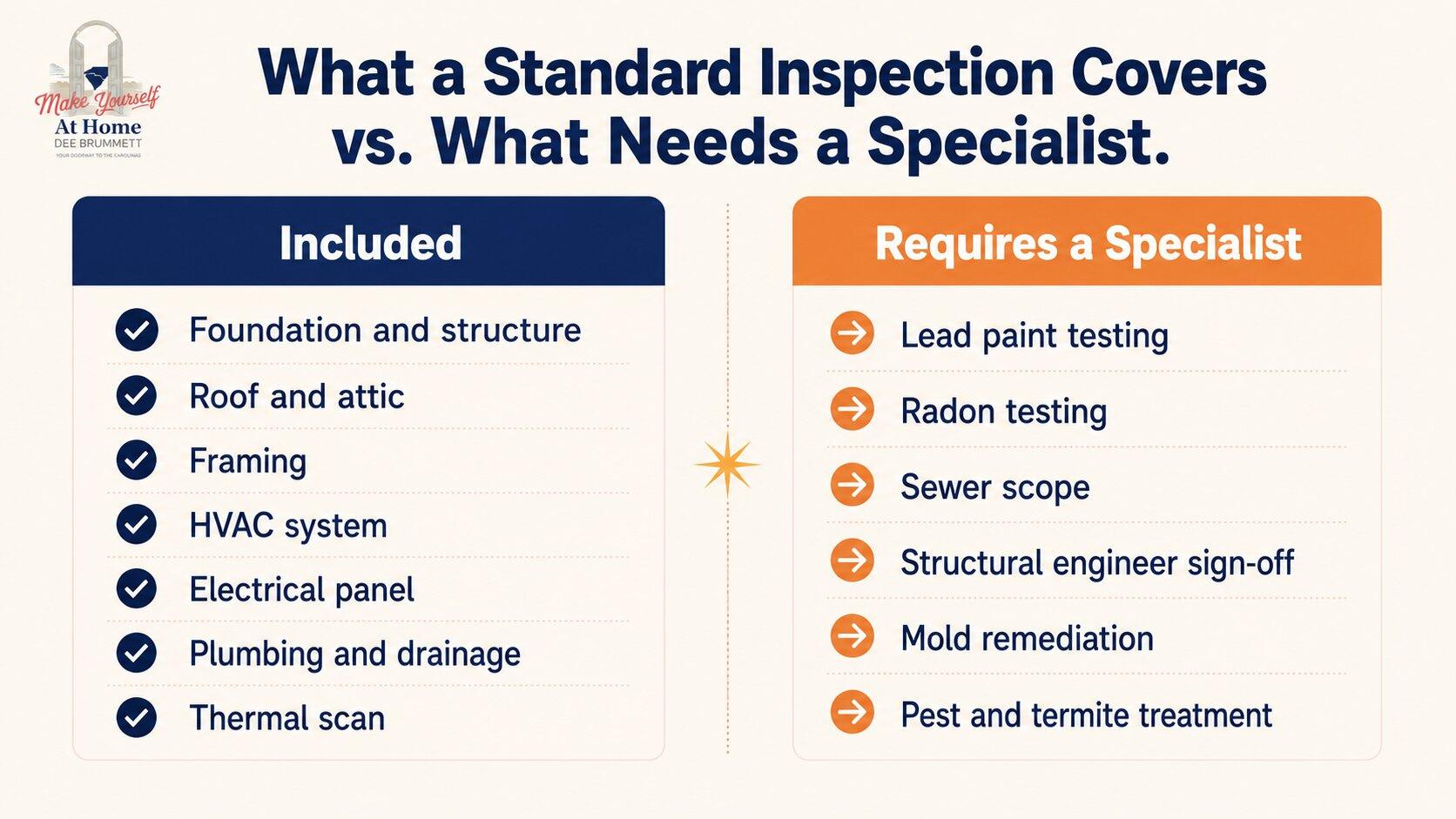
A standard residential inspection covering foundation to roof looks at structure, safety, plumbing, electrical panel, HVAC, and the attic. It does not include lead paint testing, anything invasive, or opening up walls.
Jordan's analogy for this is the best one I have heard. He is your primary care physician, not a specialist. He takes your vitals, stress tests the plumbing, and refers you out when something comes back off.
That framing matters because it sets expectations before the report lands instead of after. Both Carolinas license inspectors, and the InterNACHI Standards of Practice spell out the scope in plain language if you want to skim it. The North Carolina Department of Insurance oversees licensure on the NC side.
On timing, he is firm. Inspections run two and a half hours minimum, three to four on average, even on a small house. He wants clients there for the last half hour, not the whole thing, because a distracted inspector misses things.
The closing walkthrough is where the value lands. He shows you the defect in person, points to its exact location, and you still get it documented with video in the report. Two chances to actually absorb it.
The Two Inspection Decisions That Quietly Cost Buyers the Most Money
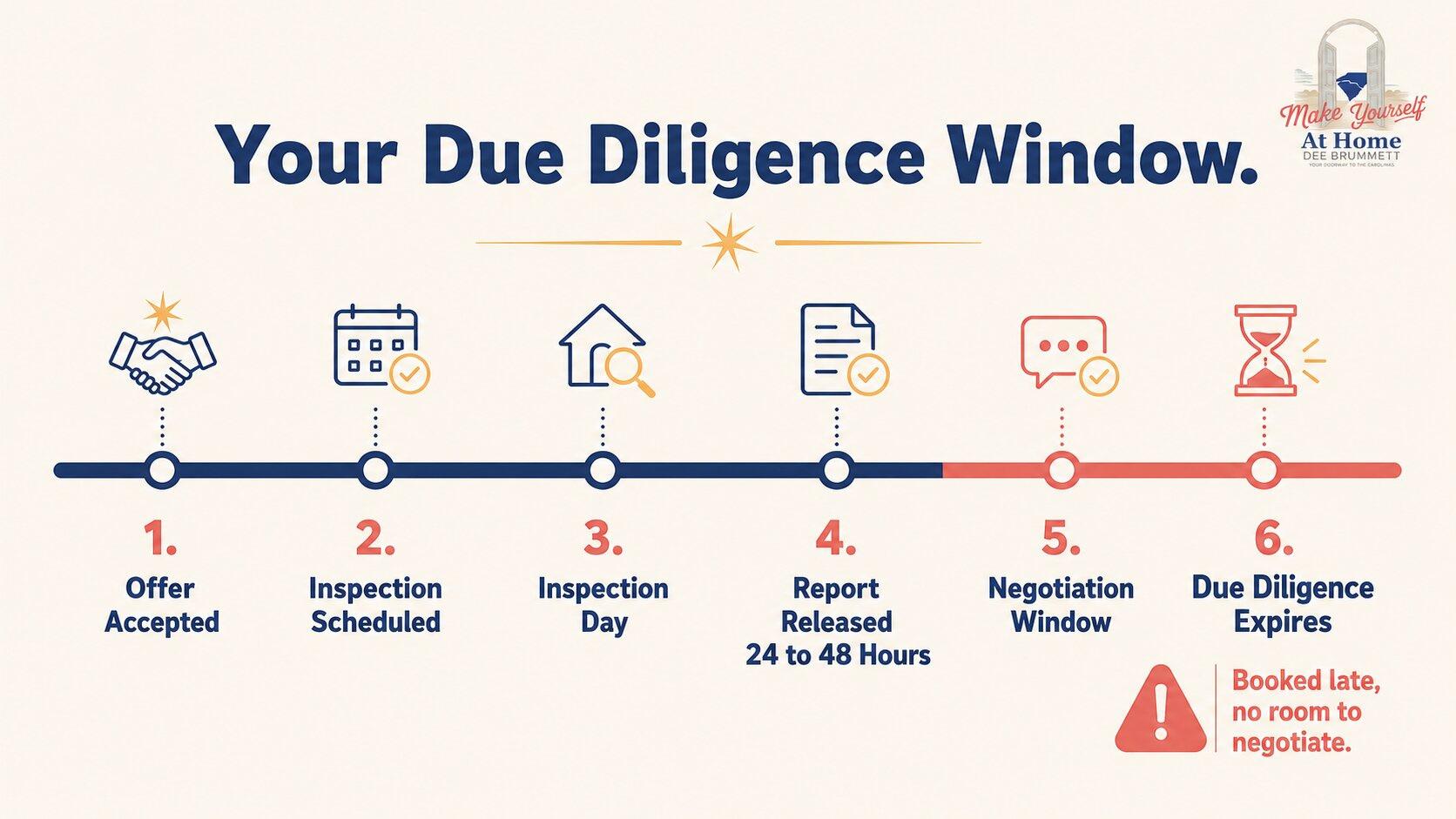
The first mistake is waiting too long. Reports take at least 24 hours to turn around, and due diligence windows in a competitive Charlotte market are short. Booking on day six of a ten day window creates chaos for everyone at the table.
The second mistake is shopping on price, and Jordan broke down the math better than I could have.
# HTML Quote ```html
“Waiting too late, I think, is the biggest mistake people make. Second is going for the cheapest inspection. We're not doing work, right? We're not grabbing tools, equipment, making repairs. So as far as the value on that end, that's not really what's lacking. What is lacking is time. In order to make what an inspector at a competitive rate makes, about the same across the board with most other qualified and good inspectors, that cheap inspector has to do a lot more inspections. What does that mean for you? Less time in your inspection. So that inspector, instead of taking those three, four hours, might be taking two and a half hours. They might not be using the same equipment. If it's a multi-inspector company, they're probably not giving you the best service, because they've got to make up for that pay.”
```
An inspector is not buying materials. The only variables that can be cut are time and equipment, and both of those are the product.
He also pushed me on something I had not thought about. Vet the inspector as a communicator, not just as a license number. A first-time buyer in their twenties needs a different explanation than a seasoned investor, and not every inspector can flex that far. His advice to clients is that you are assembling a team and you are the boss of it. There are enough agents and enough inspectors out there that if one does not gel with you, go find one who does. If you are just starting the process, my guide for buyers in the Charlotte metro walks through how the rest of that team fits together.
Why a Camera That Reads Temperature Finds Leaks Your Eyes Never Will
Let me clear up the biggest misconception first. Thermal imaging in a home inspection does not see through walls. It reads temperature differences, and those differences point you toward what to investigate.
What it actually catches is real. A supply vent not moving enough air. Attic insulation with an R-value gap that shows up on your energy bill. Moisture hiding behind a toilet where your eyes would skip right past it.
His workflow is what makes the tool work. He fills sinks and tubs upstairs early, works the exterior, then scans ceilings on the way back through so a slow leak has time to bloom. Then he confirms with a moisture meter before writing anything down.
Most companies price thermal as an upgrade. Fireline builds it into the base fee because it makes the underlying visual inspection more defensible. Drone roof inspections fill the other gap, covering two-story and steep-slope roofs a ladder cannot safely reach. He still prefers walking a roof when he can.
There are camps on both sides of this. Some argue walking a roof damages shingles; others say drone-only is a shortcut. Knowing both arguments exist helps you ask better questions.
I brought up a mutual acquaintance whose new build had a nail gun pierce a PEX line behind a baseboard. The nail held the pipe closed for seven months before it rusted out and let go. Jordan's answer was honest. Without a temperature differential, thermal probably would not have caught it. A pre-drywall inspection for new construction would have, because a nail guard should have been there in the first place.
Why a Brand New House Still Needs Three Separate Inspections
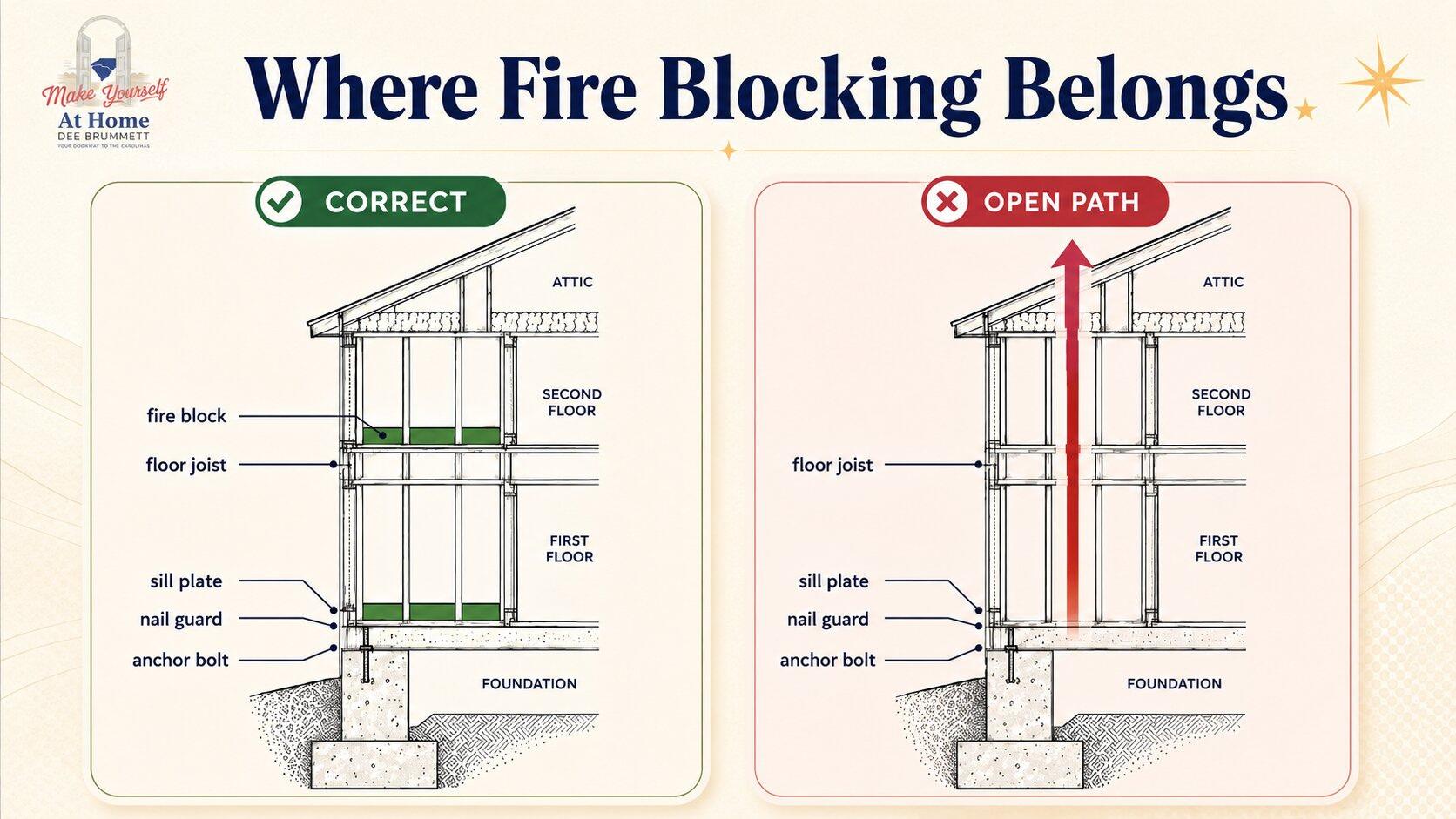
This is where the conversation got serious. Jordan described a custom ranch build where he reached the last attic section, turned right, and saw straight down to the foundation.
# HTML Quote ```html id="8f2kqm"
“I got to the last attic section, and I turn to my right, and I look over, and I see from the foundation all the way up into the attic, and they've got spray foam insulation everywhere. To the untrained eye, that probably isn't anything crazy. The joke was made, oh, it's probably just some storage. No, you need to have fire block in there, because what you have is how they built back in the 30s, 40s, 50s: balloon framing, where there's no blocking between the floors. And what that causes is an easy path for fire. It would have gone straight up, because smoke travels up. It would have gone across the entire span of the attic, and then the house would have been a total loss. And when that was presented to the builder, the builder was flabbergasted by it. Like, I can't believe we missed it. I can't believe the county inspector missed it. I can't believe the contractors coming in and working on the HVAC system and everything else missed it.”
```
Nobody was negligent. The builder, the county inspector, the HVAC crew, and every trade that walked that attic all missed it. Homes are built by human beings, and a superintendent watching a dozen trades cannot catch everything.
Fire containment is the whole point of blocking, and the U.S. Fire Administration data on residential structure fires shows how fast an open vertical path changes an outcome.
A proper new construction home inspection happens three times. Pre-drywall before the walls close up, a final before closing, and one at eleven months after a full year of heat cycles. If budget forces a cut, skip the middle one.
Pre-drywall is the one that pays. Nail guards, sill plates, anchor bolts spaced four to six feet with two per plate, missing fire foam, window wrap not carried fully inside. Your photos also become a permanent map of where every pipe and gas line runs, which you will thank yourself for the first time you hang a TV.
He has also found condenser units on the wrong breaker, a 30 amp where a 25 amp was specified, more than once. Small oversight, real consequence.
What impressed me most was his approach to builders. Instead of playing superhero, he calls the defect out and notes in the report that it may match manufacturer specifications, then asks the builder to document it. That one sentence defuses most of the friction. Talking to the superintendent on site usually reveals the remediation is already planned.
The commercial parallel he shared made the point brutally. He flagged open knockouts, double-tapped breakers, and a wire pulling loose in a flex building on a Friday. That unit caught fire Saturday night from an overheated light fixture.
How This Conversation Changed the Way I Prep My Buyers
I used to treat the inspection as a hurdle in the transaction. Now I treat it as the moment my client learns how their house actually works.
# HTML Quote ```html
“I try to be as descriptive as possible with our report writing. In the home inspection field in North Carolina we actually have a process called DDI, where we have to describe, determine, implicate, and then pretty much recommend a contractor. So I try to follow that. This is what I see. This is what it could possibly mean. This is what I recommend doing. And if you explain it like that, from what I found most people, it takes the anxiety off of the questions of like, how bad is this? Is this something I need to really worry about, or is it something I just need to be aware of? It leaves too many open-ended questions for people who are investing 300, 400, 500 thousand dollars, if not more, into a house on a property, and they're like, I just got a sentence saying this is wrong. So this is their biggest investment.”
```
Report language is a client experience issue. A one-line finding on a $400,000 purchase sends a buyer spiraling. A paragraph with cause, consequence, and next step does not.
So I prep clients on the routine stuff ahead of time. The burned-out bulb that gets flagged as a possible fixture issue. The downspout draining toward the foundation. The faux stone the manufacturer requires one way and the state calls out another.
I also book the inspection early in due diligence instead of on day six, hand new-build clients the three-inspection schedule the day they go under contract, and send them straight to the inspector with questions instead of playing telephone.
Moisture control was his other big Carolina warning, and it is the simplest fix in this whole article. Run your bathroom fan. Steam with nowhere to go creates the damp environment mold needs, and the EPA's guidance on moisture and mold backs up his point that controlling water solves the problem before it starts. Mold and air quality testing is worth adding if anyone in the household is sensitive to allergens.
Looking ahead, he sees the field maturing past the guy with a screwdriver and a flashlight, with better education and more first responders coming in. His long-term goal for Jordan Steward at Fireline Home Inspections is a team built on that same service mindset, and he shares resources built specifically for real estate agents with the partners he works alongside across the Charlotte metro.
Whether you are watching values in Monroe and the surrounding submarkets or getting a house ready to list with my seller preparation guide, the inspection is the step that protects the number.
Want to hear my entire conversation with Jordan Steward of Fireline Home Inspections on what standard walkthroughs miss and why new construction needs three inspections instead of none? Listen to our podcast episode!
Frequently Asked Questions
How long does a home inspection in Charlotte NC take and should I be there for it?
Plan on two and a half hours minimum, with three to four hours typical even on a smaller house. Come for the final half hour so you get the full walkthrough without distracting the inspector while he documents findings.
Is thermal imaging worth paying extra for during an inspection?
It does not see through walls, but it reveals temperature differences that point to insulation gaps, weak airflow, and hidden moisture. Some companies charge for it as an add-on while others build it into the standard fee, so ask before you book.
Do I really need an inspection on brand new construction?
Yes. Trades pass through in sequence and nobody owns the full picture. Pre-drywall catches missing nail guards, fire blocking gaps, and framing issues while they are still cheap to fix.
Which of the three new construction inspections matters least?
If budget forces a choice, skip the final inspection before closing. Pre-drywall shows you what is inside the walls, and the eleven-month inspection catches what a year of heating and cooling cycles exposes.
What should I do if the report flags something scary?
Read the recommendation, not just the finding. A good report tells you what was seen, what it could mean, and which specialist to call. Most items are maintenance, not deal breakers. My monthly Charlotte market reports can help you weigh repair costs against what the home is worth.
Apply to Be a Guest on the Make Yourself at Home Podcast
Buyers are making the largest purchase of their lives on compressed timelines, and the professionals protecting them deserve a bigger audience.
If you work in real estate across the Carolinas or beyond, in inspections, construction, lending, brokerage, or development, and you are solving problems buyers and agents actually run into, I would like to have you on the show.