
A woman buys her dream home in Boulder with her divorce settlement. Her agent tells her she can Airbnb it. Eight months later, she sells at a $400,000 loss because nobody checked the HOA rules. That story alone should terrify every buyer who picks an agent off a Facebook comment thread - and it’s exactly why Taylor Ratliff, a Westminster Colorado real estate agent with five years of multimillion-dollar production, has built her entire practice around one principle: education before emotion.
I sat down with Taylor on the Make Yourself at Home podcast for a conversation that every buyer and seller in the Denver metro needs to hear. From predatory down payment programs to the most dangerous catchphrase in real estate, Taylor held nothing back.
By the time you finish this article - based directly on our conversation - you’ll discover:
-
Why the way you find your agent can make or break your transaction
-
The truth about interest rates, buydowns, and that “marry the house, date the rate” phrase
-
How misinformation from professionals is driving real buyers into foreclosure
-
Practical strategies to beat decision fatigue during your home search
-
Why starting the process 1–2 years early changes your entire outcome
And if you’re ready to dig deeper, here’s the full conversation:
Who Is Taylor Ratliff & Who Does She Serve?
A Colorado Realtor Built on Communication and Education

Taylor Ratliff is a Colorado residential realtor based in Westminster, serving buyers and sellers across the Denver metro area. Over five years, she’s helped clients navigate purchases, sales, and relocations with one guiding principle: make sure every client actually understands what’s happening at every step of the process.
She’s helping not only relocation clients, but clients navigate purchase sales, focusing on clear communication and personalized service.
Based on what we’ve seen, she is a multimillion dollar agent with multiple transactions, homes ranging from entry-level all the way up through mid-range points.
The Problems Taylor Specializes in Solving
If any of the following sounds like your situation, you’re in the right place:
-
Overwhelmed by conflicting advice from social media, news, or well-meaning friends
-
Picked an agent out of convenience, and not sure they’re performing
-
A first-time buyer who doesn’t know what questions to ask or where to start
-
A seller making an emotional decision who needs steady, strategic guidance
-
Feeling pressured to move faster than you’re comfortable with
Taylor’s approach as a Denver metro buyer agent and Westminster CO listing agent is built around: slowing down, asking better questions, and making sure you leave every conversation more confident - not more confused.
Now let’s get into the single biggest mistake Taylor sees buyers and sellers make right from the start.
The #1 Problem: Buyers Aren’t Interviewing Agents
The Convenience Trap
Here’s how it usually plays out: you decide you’re ready to buy, post in a Facebook group asking for realtor referrals, and twenty names flood in within an hour.
You pick the first one. No calls to the others. No questions asked.
That’s the convenience trap - and according to Taylor Ratliff, it’s the number one way buyers set themselves up for a painful, expensive experience.
"The number one thing that I see is that people are not doing their own due diligence in the beginning, and this truly is a team effort and you have to want to be in control of your decisions and your future. And so that’s the biggest thing, is that they think that the agent is going to take them the entire way, and that is our job, but we do it together."– Taylor Ratliff, Westminster Colorado Realtor
Why Interviewing Agents Actually Matters
Knowing how to interview a real estate agent isn’t just due diligence - it’s self-protection. Think of it like a job interview. You wouldn’t hire someone to manage your finances without vetting them first. Your home is likely the biggest financial move you’ll ever make.
"You need to ask the hard questions so that you know that you’re working with a good agent."– Taylor Ratliff, Westminster Colorado Realtor
Because, as I’ve always said, just because you know somebody doesn’t mean they’re good at what they do. This is a team sport.
How to Interview a Real Estate Agent: Questions That Reveal Everything
Use this as your starting-point checklist:
|
Question to Ask |
What It Reveals |
Why It Matters |
|
How many transactions have you closed in the last 12 months? |
Current activity and market experience |
Low activity can mean limited current knowledge |
|
How often will you communicate, and how? |
Responsiveness pattern |
Ghosting is the #1 complaint about agents |
|
Do you specialize in buyers, sellers, or both? |
Specialty alignment |
You want someone whose expertise matches your need |
|
Walk me through how you handle inspection issues. |
Problem-solving ability |
Deals rarely go perfectly; judgment matters |
|
Do you have trusted lenders and inspectors? |
Network and support system |
A strong team reduces your burden significantly |
|
Tell me about a deal that got complicated. |
Judgment under pressure |
How they handle problems reveals who they really are |
If you walk away from that conversation with more questions than answers, keep interviewing. The right agent will make you feel capable and guided from the very first call.
But interviews aren’t the only thing buyers get wrong at the start. There’s another shortcut that can cost far more - hiring a friend.
|
✅ Taylor’s Agent Interview Checklist
|
Why Hiring a Friend Can Be a Financial Mistake
The Friend Problem in Real Estate
The question of should you hire a friend as your realtor comes up constantly. Taylor’s answer is nuanced but firm: it’s not about whether they’re your friend. It’s about whether they’re genuinely qualified - and whether the friendship will actually hold them professionally accountable.
She shared a real, active client situation:
“This is not the market to be working with a friend. I have a relocation client that wants to move to Colorado. Their house has been on the market for close to a hundred days now, and he is doing his own open houses. I am helping him do his own social media ads because the agent is somebody in the community - it’s a friend. He said that if he didn’t list with him, he thought he’d put in a bad rap for him. He is potentially making one of the biggest financial mistakes of his life because he is working with an agent that is not working for him.”– Taylor Ratliff, Westminster Colorado Realtor
Friendship vs. Professionalism: The Line That Matters

The client in that story was running his own open houses and managing his own social media while still paying an agent who wasn’t performing. That’s money leaving his pocket for nothing - and a friendship making it impossible to hold anyone accountable.
-
Work with a friend IF: they have a verifiable track record and you can hold them professionally accountable
-
Don’t work with a friend IF: the only reason you chose them is to avoid conflict or preserve the relationship
-
Red flag: you feel guilty asking hard questions - the friendship is already interfering with the transaction
Once you’ve found the right agent, the next advantage in today’s market is something most buyers don’t realize they have: time.
Practice “Slowing Down” the Process
The Market Has Changed - Use That to Your Advantage
Between 2020 and 2022, buying a home meant making life-altering decisions under extreme pressure.
-
Waived inspections.
-
Buyers offering $100,000 above asking price.
-
Decisions made on the front lawn with no room to breathe.
That era caused a lot of financial damage - and it’s the source of much of the fear buyers carry into the market today.
That market is gone. And what replaced it is actually in your favor - if you know how to use it.
“This market is more challenging for the real estate agent. But I love this market for my clients because we get to slow down and really decide - Where are you now? Where do you wanna be, and what do we need to do to get you there? Let’s see more than one home. Let’s talk about the home. How about you go out to dinner and really talk about your future and all the boxes that this home checks and all the boxes that it doesn’t.”– Taylor Ratliff, Westminster Colorado Realtor
What Slowing Down Actually Looks Like
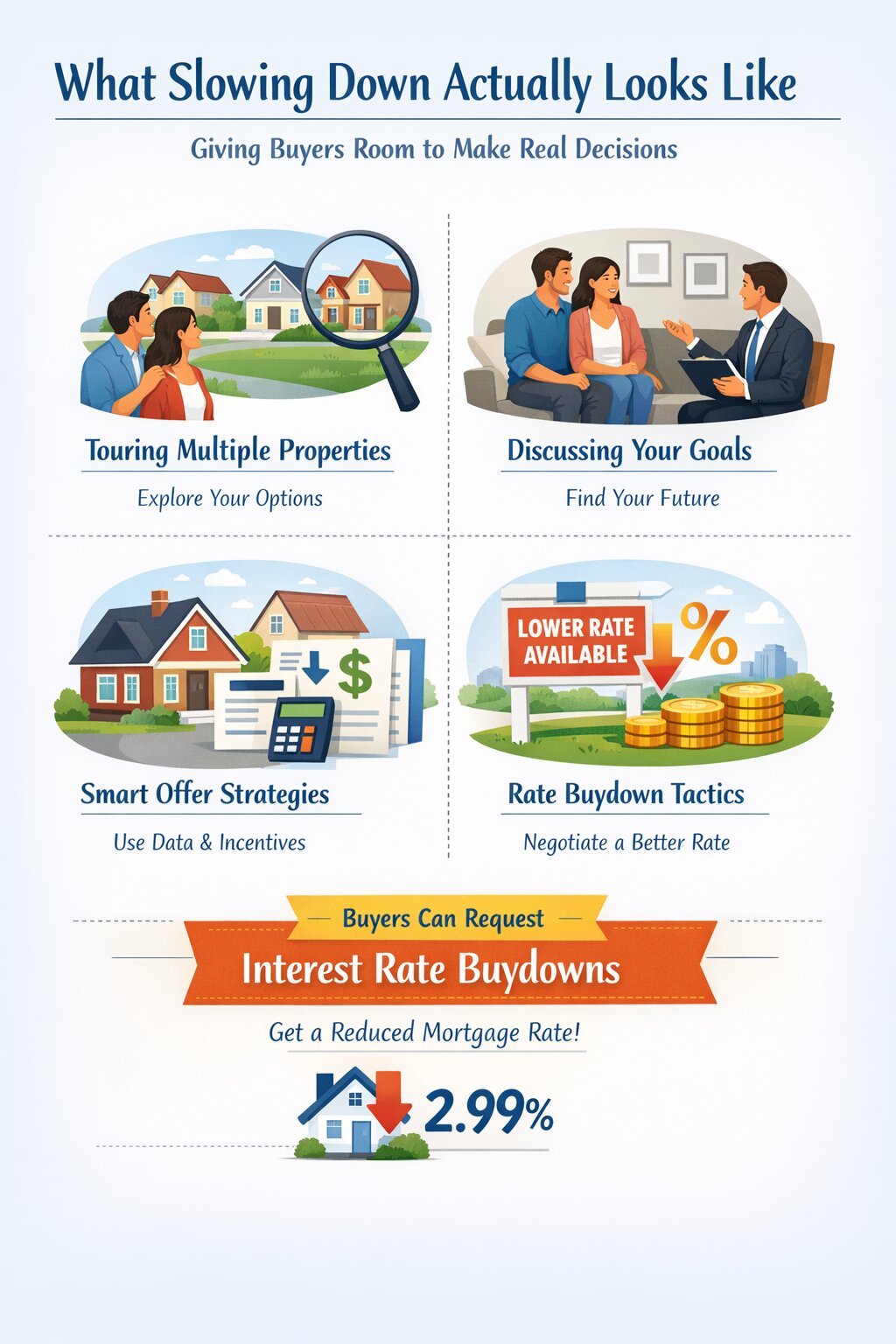
Taylor’s process in today’s market gives buyers room to make real decisions:
-
Viewing multiple properties before committing to anything
-
Real conversations about what you want your life to look like in this home
-
Using data and seller concessions to guide offers - not emotion
-
Negotiating interest rate buydowns - most buyers don’t know this is possible
On that last point: sellers can pre-advertise a bought-down rate to compete with new builders. Buyers can request concessions to fund a permanent rate reduction. Most people walk into the market thinking the interest rate is fixed. It isn’t.
Before you can take advantage of those tools, though, you need to understand what fear is actually doing to buyers right now - and whether those fears are grounded in reality.
Separate Fact from Fear: Equity Loss, Foreclosures & Crash Myths
Why Buyers Are Scared Right Now
One of the most common anxieties buyers bring into the process is driven by Colorado housing market crash fears.
And honestly, the fear makes sense.
If your neighbor bought in 2021, is now underwater, and is talking about a short sale, that story spreads fast. Bad news always does.
“There are a lot of people that bought at the height of the market and just saw their equity get wiped out by the market correction that we had. And so there’s fear because they’re seeing what their neighbors are experiencing. We are having more foreclosures. We are having more short sales. And so there is fear because they’re seeing what their neighbors are experiencing.”– Taylor Ratliff, Westminster Colorado Realtor
But here's the key thing most buyers are missing:
What we experienced in Colorado wasn't a crash. It was a market correction.
Market Correction vs. Market Crash: Not the Same Thing
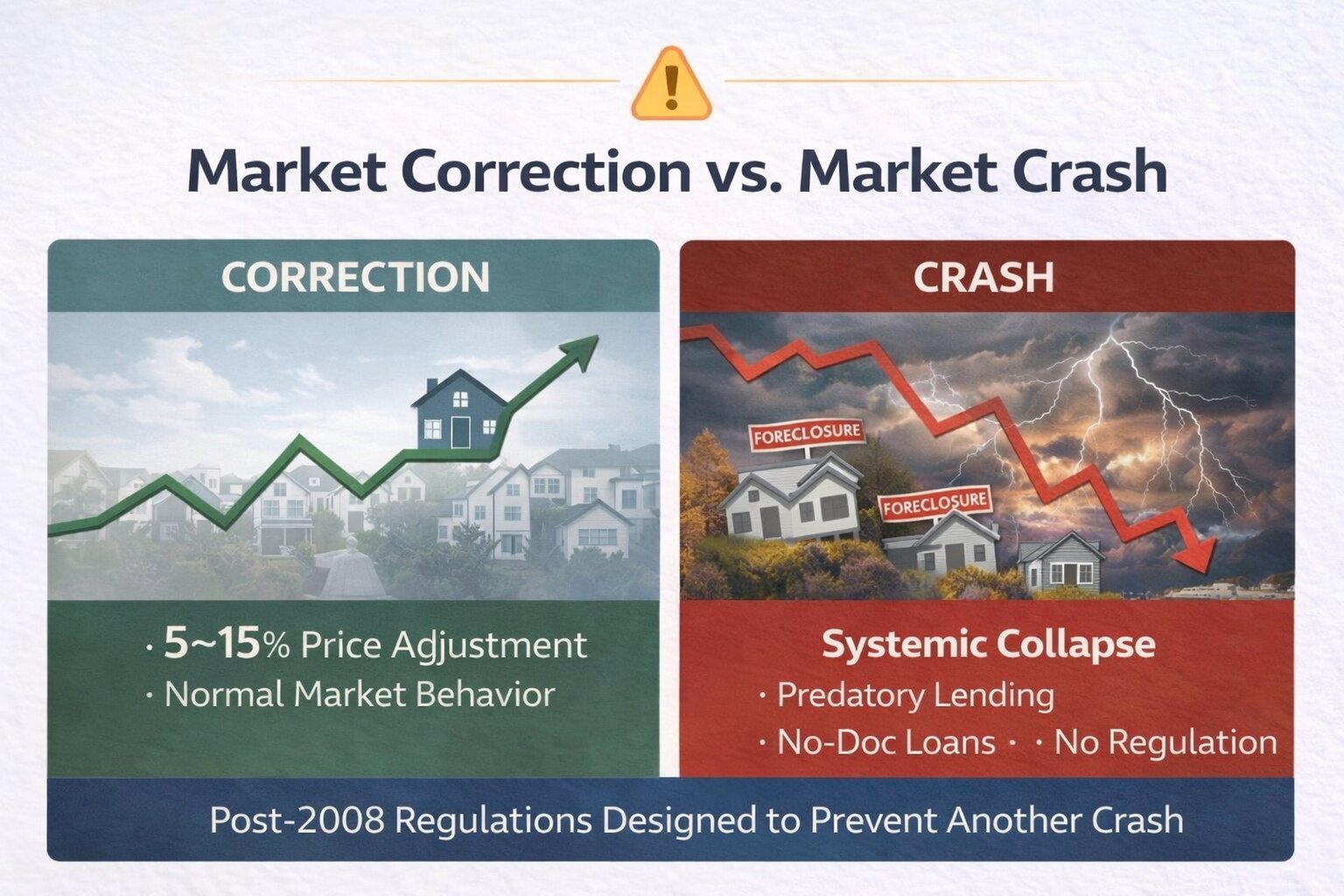
Here’s the distinction Taylor wants every buyer to have clearly: what happened in Colorado was a correction - approximately a 10% price adjustment - not a crash. A correction is healthy and expected. A crash is a systemic collapse.
“There’s a lot of people that actually are misinformed and feel that we’re going to have another market crash because of 2008, 2009, 2010. And that’s just inaccurate. We had a market correction. We will not have a market crash. There are so many rules and regulations that are in place to keep that from happening.”– Taylor Ratliff, Westminster Colorado Realtor
Here’s why there won’t be a crash in today’s market:
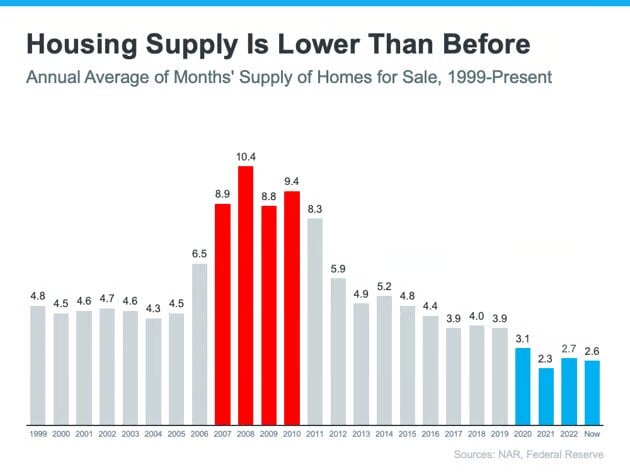
Proof #1: Inventory Is Too Low for a Crash
As shown in the graph below, current housing inventory sits at just 2.6 months' supply - far below the levels seen during the 2008 crash. With that little inventory on the market, a price collapse like the one we saw back then simply isn't supported by the data.
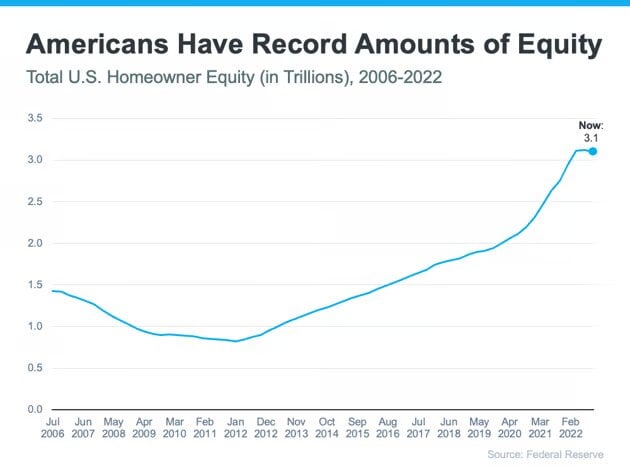
Proof #2: Homeowner Equity Is Near Record Highs
As the graph shows, U.S. homeowner equity has climbed to record levels, reaching about $3.1 trillion. This means most homeowners have a strong financial cushion, making it far less likely they’ll be forced to sell or foreclose if the market cools.
If you compare the key conditions that caused the 2008 housing crash with today’s market, the differences are clear. The fundamentals that led to the last collapse simply don’t exist today.
|
Factor |
2008 Crash |
Today’s Market |
|
Lending standards |
Extremely loose, largely unregulated |
Post-Dodd-Frank protections in place |
|
Inventory |
Massive oversupply |
Still undersupplied in many Colorado markets |
|
Buyer qualification |
Minimal income verification |
Strict income and credit documentation required |
Fear in real estate is contagious. When someone hears about a neighbor losing equity or selling at a loss, it can feel like the entire market is collapsing.
But real estate decisions should never be based on someone else’s anecdote.
They should be based on your finances, your timeline, and the actual market data.
And right now, the biggest data point most buyers misunderstand isn't prices.
It’s interest rates.
"Marry the House, Date the Rate" - Why That Advice Can Be Dangerous
The Phrase Everyone Is Repeating
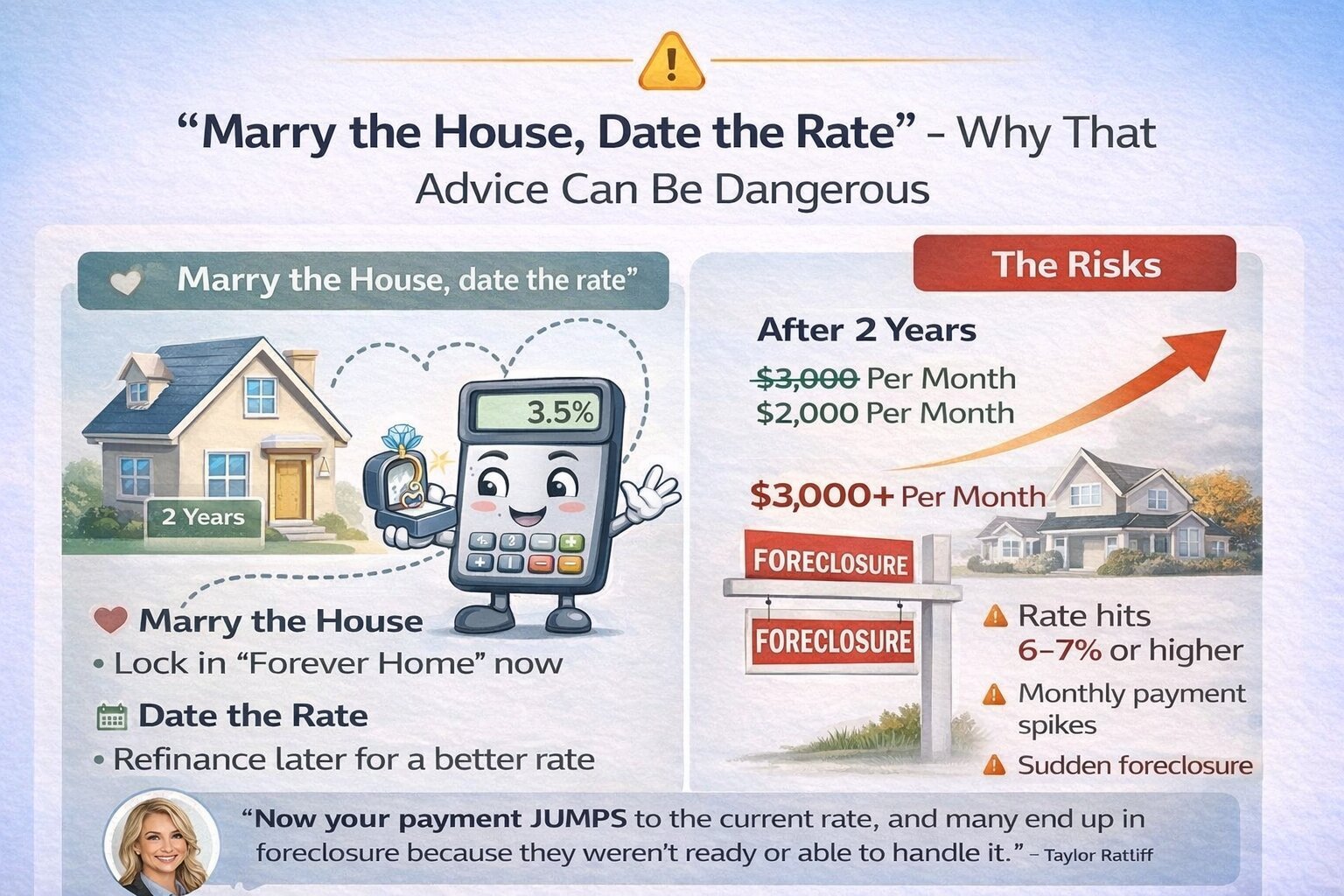
If you’ve spent any time in real estate conversations lately, you’ve heard it. The marry the house date the rate meaning is: lock in your forever home now and refinance when rates drop. It’s catchy. And according to Taylor, it’s the worst advice in real estate.
“Marry the house, date the rate - worst advice ever. And that’s what is really getting people into these foreclosure situations in Colorado. You had a lot of agents that were recommending a two-one buydown, a 3-2-1 buydown instead of a permanent rate buydown. People were looking at a $2,000 payment and saying that’s incredible. Well after two years, that payment jumps to the current market rate and they were not educated to think ahead and future plan. Is the monthly payment something you can afford?”– Taylor Ratliff, Westminster Colorado Realtor
2-1 Buydown vs Permanent Buydown: The Difference That Matters
A buydown is when someone - the seller, a builder, or you - pays money upfront to temporarily or permanently lower your mortgage interest rate. The lower the rate, the lower your monthly payment.
The problem is that not all buydowns work the same way. Some are temporary, and when they expire, your payment jumps - sometimes by hundreds of dollars a month.
Here’s the breakdown:
Temporary vs. Permanent Buydown Comparison
|
Factor |
||
|
Initial Payment |
Lower (subsidized) |
Slightly higher |
|
After 2 Years |
Jumps to market rate |
Stays the same |
|
Foreclosure Risk |
HIGH if buyer can’t absorb increase |
LOW — predictable payments |
|
Best For |
Buyers certain they’ll refinance soon |
Buyers who want long-term stability |
Many buyers were drawn in by the low payments that came with temporary buydowns without being told that those payments would eventually go up. That gap between the discounted payment and the real one is what's pushing people into foreclosure right now.
In many cases, a permanent buydown costs only slightly more upfront than a temporary one - and it protects buyers from exactly the payment shock currently driving foreclosures.
The Budget-First Rule
“The pre-approval amount does not matter at all. I don’t care what you’re pre-approved for. I care what your maximum monthly budget is, and then we match it to the purchase price. Because if you are uncomfortable in the payment that the house is going to give you, you're going to end up selling or you're going to be house poor.”– Taylor Ratliff, Westminster Colorado Realtor
Stop asking what you’re pre-approved for. Start asking what monthly payment you can actually live with. That reframe is one of the most practical ways Taylor helps buyers understand how to avoid foreclosure after buying.
Once you have your loan structure right, the next layer is your down payment strategy - and this is where emotional marketing can lead buyers in the wrong direction.
For Down Payment Assistance: Prioritize Education Before Emotion
The Lesson Taylor Learned the Hard Way

Not all down payment assistance programs are created equal and Taylor learned that firsthand. Early in her career, Taylor was invited to promote a down payment assistance program at a concert in Denver. The marketing was emotionally powerful - targeting communities of color and framing homeownership as doing what your ancestors never could. She was excited. Until she read the fine print.
“If you sell, you have to pay it back plus 5% of the value of the home at the time that you sell. So you’re giving somebody $40,000 and then attaching a 5% fee to the value of the home. That just turned into $65,000. When is that person ever going to be able to pay that off? That was the biggest lesson that I have ever learned in my career because I was somebody that was promoting information that I thought was a good thing to promote.”– Taylor Ratliff, Westminster Colorado Realtor
The Programs That Actually Help Colorado Buyers
That experience is exactly why Taylor is careful about which programs she recommends. Colorado has real, legitimate down payment assistance Colorado options. CHFA - the Colorado Housing and Finance Authority - offers programs that have helped buyers get into homes with very little out of pocket. Taylor has used CHFA successfully with her own clients.
“Colorado specifically, we do have CHFA which is the Colorado Housing and Finance Authority. You can get into a home with as little as a thousand dollars and the state will pay the remaining amount. But there’s also a product that is a second mortgage, and you have to pay it off before you refinance. So you really need to do future planning.”– Taylor Ratliff, Westminster Colorado Realtor
Grants vs. Second Mortgages: Know the Difference Before You Sign
|
Grant |
Second Mortgage |
|
Does not need to be repaid |
Must be repaid before refinancing or selling |
|
No lien on the property in most cases |
Creates a lien that directly affects your equity |
|
Better for long-term financial flexibility |
Can trap buyers who need to move or refi early |
|
Verify eligibility requirements with your agent |
Always model the payoff scenario before accepting |
Assistance programs can be powerful tools when used correctly. But emotional marketing around financial decisions is always a red flag.
-
Read the fine print.
-
Know your exit strategy.
-
And make sure your agent has done the same.
The single most protective move you can make as a buyer isn’t about market conditions. It’s about giving yourself enough time.
Start 1–2 Years Early - Aim To Be Prepared, Not Pressured
Why Most Buyers Wait Too Long
Taylor’s clearest advice on how to prepare to buy a house in 1 year is this: reach out before you think you’re ready.
Most buyers contact an agent when they need to move. Taylor wants to hear from you when you still have time to get positioned correctly.
“I always recommend for my first time home buyers to reach out to me a year, maybe even two years before they’re ready to buy a home. Because you are at point A. You want to get to point C, and we need to know everything that you need to do in the meantime in order to get you there.”– Taylor Ratliff, Westminster Colorado Realtor
The Credit Report Story That Changed How She Advises Clients
Taylor made this personal. She once discovered that her own bank had misreported 13 consecutive missed credit card payments on her report - even though she had made every payment on time. After calling the bank and disputing it, the correction still took 45 days to appear on her credit file.
<blockquote> “I had 13 missed payments misreported and my credit dropped significantly. It still took 45 days for it to reflect after being corrected. If you come to me a month before you need to buy and something is wrong, we don’t even have time for it to reflect.”
- Taylor Ratliff, Westminster Colorado Realtor </blockquote>
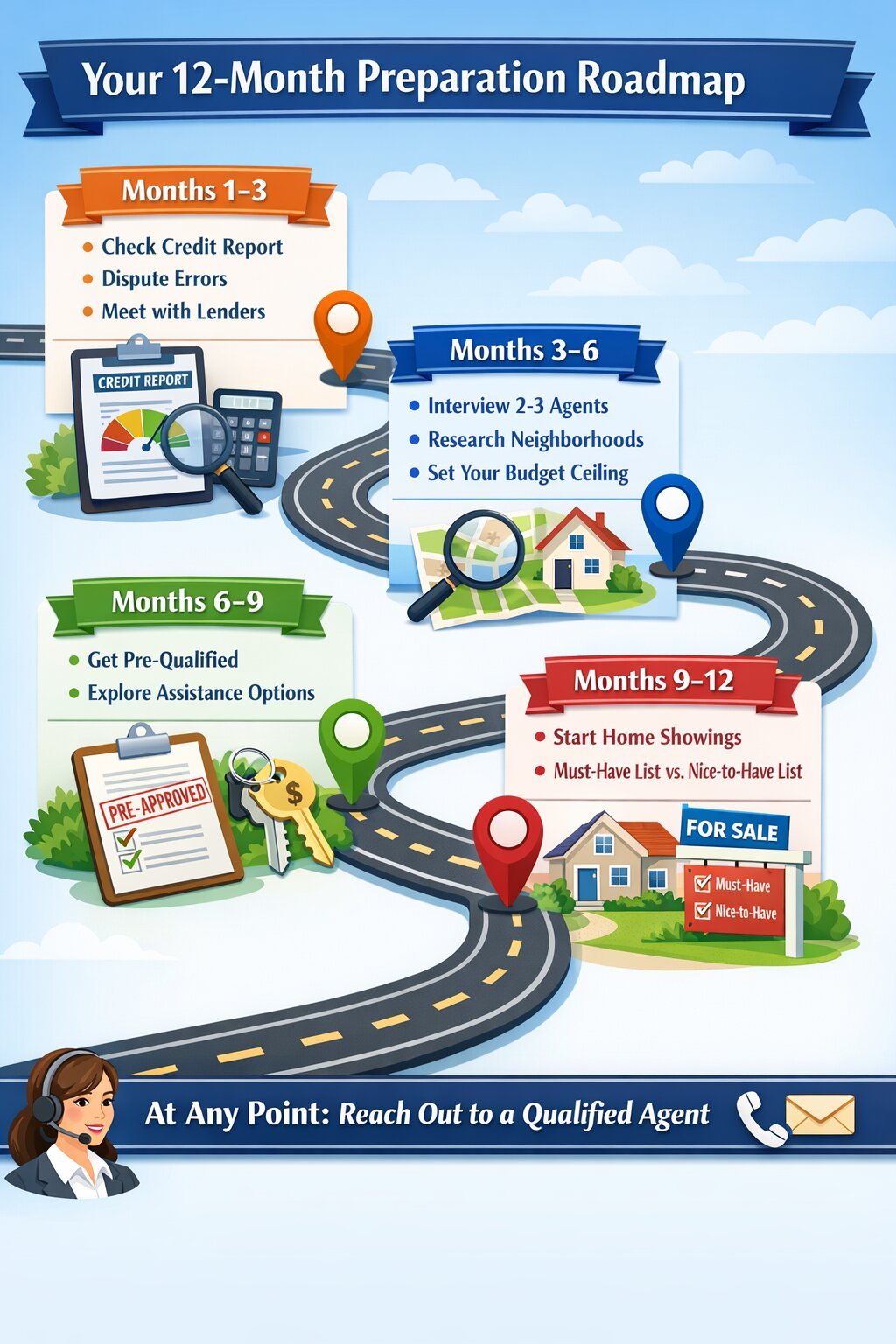
Your 12-Month Preparation Roadmap
-
Months 1–3: Pull your credit report, dispute any errors immediately, start meeting with lenders
-
Months 3–6: Interview 2–3 agents, research target neighborhoods, identify your true monthly budget ceiling
-
Months 6–9: Get pre-qualified (not just pre-approved), explore CHFA and other assistance options
-
Months 9–12: Begin targeted showings with your chosen agent, finalize your must-have vs. nice-to-have list
-
At any point: Reach out to a qualified agent - you’re never wasting someone’s time by starting early
Once you’re actively searching, the next thing to protect yourself from is one of the most underestimated challenges in home buying: decision fatigue.
Eliminate Decision Fatigue
The 200-House Problem
A Zillow report found that roughly 6 in 10 buyers found the homebuying experience stressful, and for 1 in 4, that stress reached the point of being extreme. That kind of pressure doesn't come from nowhere. Much of it traces back to decision fatigue when house hunting:
-
Too many homes,
-
Too many options,
-
Not enough structure to make the process feel manageable.
Taylor has watched decision fatigue derail buyers who were otherwise ready to commit. She’s seen clients view 200 homes without making a decision - and she’s direct about why: agents are allowing buyers to look at too much without filtering for actual fit.
“I’ve seen people look at 200 houses. There’s never going to be more than 20 homes that are going to work for a buyer. You don’t remember what the first 175 looked like. I don’t do more than six to seven homes in a day because you forget what they look like.”– Taylor Ratliff, Westminster Colorado Realtor
Taylor’s Framework for a Clean, Decisive Search
If you want to defeat decision fatigue, here’s what you need to do:
-
Cap your search at 20 homes total. If none work, adjust the criteria - not the number of showings.
-
Limit tours to 6–7 homes per day. Beyond that, details blur and decisions become guesswork.
-
Filter before you visit. A 60-minute commute when you wanted 30 is a no - no matter how nice the kitchen is.
-
Step back during inspections. Show up at the end to ask questions, not hover through the whole thing.
Protect Yourself From Misinformation
The Stakes Are Higher Than People Realize
This was the part of our conversation where Taylor got visibly emotional - and honestly, so did I. Learning how to avoid bad real estate advice isn’t just about protecting your investment. It’s about protecting your life.
“You can be the best person in the world, and you can be a realtor that guides somebody to a terrible point in life. If you don’t fully understand everything that you are saying, you might be giving somebody a piece of information that they’re going to go really mess up their life with.”– Taylor Ratliff, Westminster Colorado Realtor
How Misinformation Can Ruin Lives
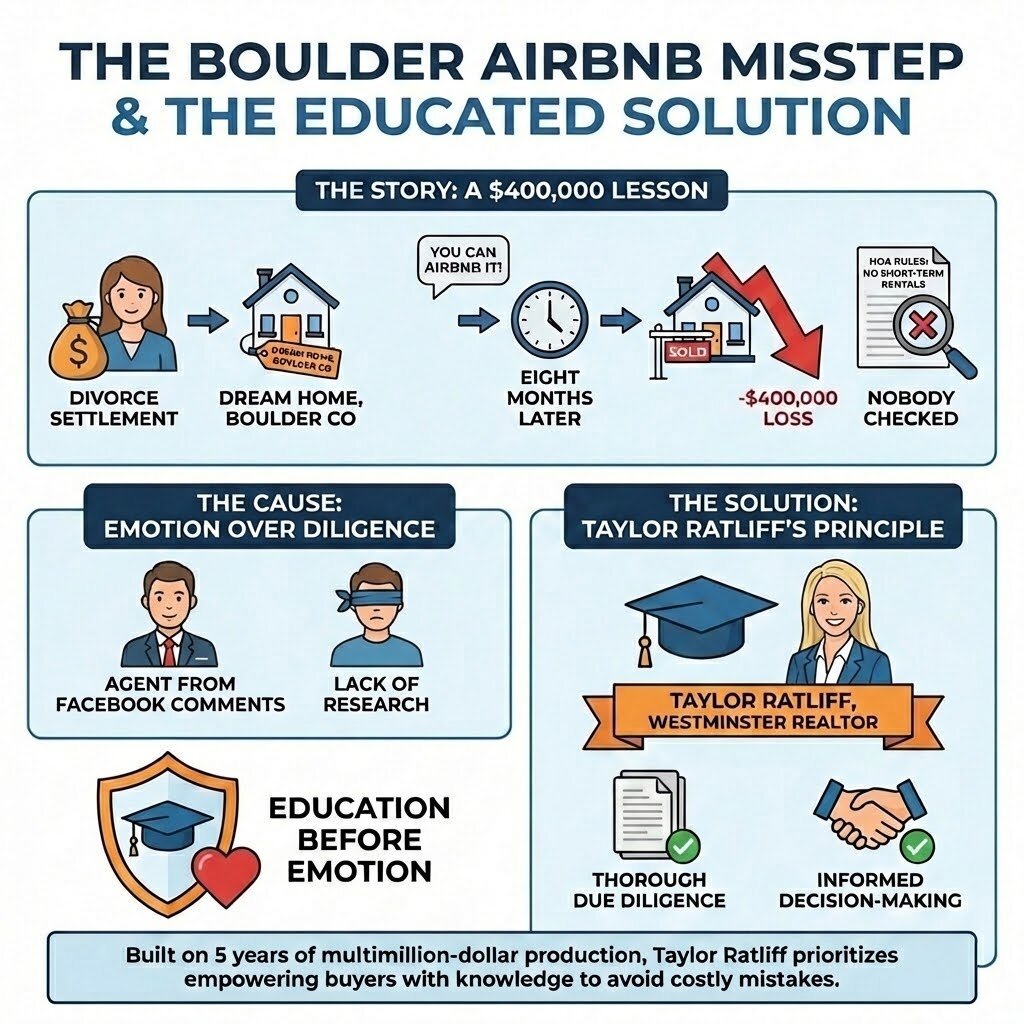
She shared a specific case from her experience. A woman relocated from North Carolina to Boulder, Colorado. She paid $600,000 over asking for her dream home using money from her divorce settlement. Her agent told her she could Airbnb the property to offset costs. Nobody checked the HOA documents. The private HOA threatened to sue her for every dollar she’d made from short-term rentals.
“She bought that home with her divorce money. Her agent told her she would be able to Airbnb it. It was a private HOA. She sold at a $400,000 loss after eight months.”– Taylor Ratliff, Westminster Colorado Realtor
Eight months. $400,000 gone. One phone call to the HOA - one read-through of the covenants - that’s all it would have taken.
Misinformation Protection Checklist: (Check This Before You Buy)
-
Request and read the full HOA covenants, conditions, and restrictions (CC&Rs)
-
Verify short-term rental eligibility independently - never rely solely on the seller’s word
-
Ask your agent to research local Airbnb/VRBO restrictions and applicable zoning rules
-
Run a long-term scenario: what if you need to sell within 1–2 years?
-
If your agent can’t answer these questions with documentation, find one who can
The gap between a life-changing transaction and a life-altering mistake often comes down to how invested your agent is in your full situation. That’s exactly what the final section is about.
When to Prioritize Personalized Service Over Efficiency
Why People Remember How You Made Them Feel
Taylor is self-aware about this: she’s still working on efficiency. She’s the kind of agent who spent six hours at her first listing appointment because her client made homemade gluten-free gnocchi and they picked blackberries from the backyard. She doesn’t apologize for it.
“In this industry, it’s all about how you make people feel. They forget the entire process because they don’t really care about that. They just want to feel good. If you can make people feel good, that’s what keeps them coming back to you.”– Taylor Ratliff, Westminster Colorado Realtor
The Christmas Tree
Taylor shared a story that I’ve thought about many times since our conversation. A divorce client - a father fighting for custody of his daughter - told Taylor his one goal: to be in a home by Christmas so his little girl could have a Christmas tree and they could play board games together.
The home he could afford wasn’t the one he originally wanted. But it was the one that mattered.
“His main goal was that he was going to be in a house by Christmas so that his little girl could have a Christmas tree. For the final walkthrough, I decorated the home with lights and a Christmas tree. He just breaks down crying on the ground. That’s what it’s about.”– Taylor Ratliff, Westminster Colorado Realtor
That’s the kind of Westminster Colorado real estate agent Taylor is. Present, invested, treating every transaction as a life chapter. If you’re looking for a Taylor Ratliff Westminster Colorado Realtor who shows up like that, reach out to her directly. Her contact information is just below.
Frequently Asked Questions
1. How Do I Interview a Real Estate Agent in Colorado?
Ask about recent transaction history, communication style, and their network of inspectors and lenders. If you leave the conversation with more questions than answers, that’s your answer. Knowing how to interview a real estate agent means asking hard questions and watching how they handle them.
2. Should I Hire a Friend as My Realtor?
Should you hire a friend as your realtor? Only if they’re genuinely qualified and you can hold them professionally accountable. According to Taylor, friendship-based hiring is one of the most common - and costly - mistakes buyers and sellers make.
3. Is the Colorado Housing Market Going to Crash?
No. Colorado had a market correction of roughly 10%, not a crash. Post-2008 regulations are specifically designed to prevent systemic collapse. Colorado housing market crash fears are understandable, but the data doesn’t support them.
4. What Is a 2-1 Interest Rate Buydown?
In the 2-1 buydown vs permanent buydown comparison: a 2-1 temporarily subsidizes the rate for two years, then reverts to the full market rate. Buyers who aren’t prepared for that jump face payment shock - a documented driver of foreclosures.
5. Is “Marry the House, Date the Rate” Good Advice?
Taylor calls it the worst advice in real estate. The marry the house date the rate meaning - lock in the home and refinance later - assumes rates will drop in a way that has already pushed real Colorado buyers into foreclosure.
6. How Does CHFA Down Payment Assistance Work?
CHFA offers both grants and second mortgages to help with down payment assistance Colorado. Grants don’t require repayment. Second mortgages do, and must be paid off before refinancing or selling. Always understand the repayment structure before accepting.
7. How Far in Advance Should I Contact a Realtor?
Taylor recommends 1–2 years before your target move date. That’s the core of how to prepare to buy a house in 1 year - start early enough to fix credit, build your team, and position yourself for the best possible terms.
8. How Do I Avoid Foreclosure After Buying a House?
Focus on your maximum monthly budget, not your pre-approval amount. Avoid temporary buydowns without a confirmed refinancing plan. And understand every assistance program’s repayment terms. Taylor’s approach to how to avoid foreclosure after buying starts at the very first conversation.
9. How Many Homes Should I See Before Making an Offer?
Taylor caps it at 20 total and no more than 6–7 per day. Overexposure creates decision fatigue when house hunting and makes the decision harder, not easier. A good agent filters before you walk through the door.
10. What Should I Look for in a Westminster Colorado Realtor?
Clear communication, data-driven guidance, education without pressure, a trusted network, and someone who asks about your monthly budget - not just your pre-approval. That’s the standard Taylor Ratliff Westminster Colorado Realtor holds herself to.
|
🔗 Connect with Taylor Ratliff Facebook: facebook.com/TaylorRatliffRealEstateCO Instagram: @taylorratliff_realtor LinkedIn: linkedin.com/in/taylor-ratliff-220178378 |
This podcast is produced by the Icons of Real Estate — #1 Real Estate Podcast Network
Apply to Be a Guest on the Make Yourself at Home Podcast
If you serve the real estate industry - through staffing, lending, brokerage, technology, or advisory - and help agents grow smarter, not harder…
Let’s spotlight your insights.
Apply to be featured on the podcast.