What if a single rental property could generate two to three times the cash flow you’re making right now—without buying another house?
That’s the promise behind PadSplit co-living investment, and after sitting down with Devon Aguirre on the Make Yourself at Home Podcast, I’m convinced this model is one of the most overlooked opportunities in real estate today.
Devon is the Southern California Market Manager for PadSplit — a proptech platform built around co-living real estate investment and affordable housing. He walked me through exactly how co-living works, who it serves, and why investors across the country are ditching traditional long-term rentals for this approach.
If you’ve got a property sitting vacant or barely breaking even, this conversation will change the way you think about rental income.
Who Is Devon Aguirre & What Is PadSplit?
One of the first things Devon did on our call — and I really appreciated this — was to clear up the vocabulary. Because PadSplit has its own language, and if you don't know it going in, you'll get lost fast.
"So we call our owners, operators, investors, hosts, and then we call our tenants members. I always like to clear up the vocab in the beginning because as we go through, I'll start saying those things and then nobody will know what I'm talking about. At the end of the day, what we are is just an online platform that connects those hosts with those members. So we don't hold any of these assets ourselves or anything like that."
"So co-living in general is just how you described it, right? It’s people living together in shared housing. There are different ways to structure co-living. Some people do it like by the bed, almost — two people sharing individual beds in a room. We operate on an individual-room basis, but for the most part, it’s essentially dorm-style living for adults. People sharing a room sometimes have private bathrooms if they rent, like the master bedroom, but most of the time, rooms are going to have a shared bathroom. You have three or four bedrooms sharing a bath, and that’s the idea."
"You have some members who are looking to save money — a waiter who doesn't bring in that much income, or senior citizens on fixed income who'll never afford a studio apartment. Then you have younger people who say, 'I don't want to be straddled to a two grand a month rent payment. I want to live my best life.'"
"Our average stay currently is about eight and a half months. But we have PadSplit members that have lived in certain properties for three or four years."
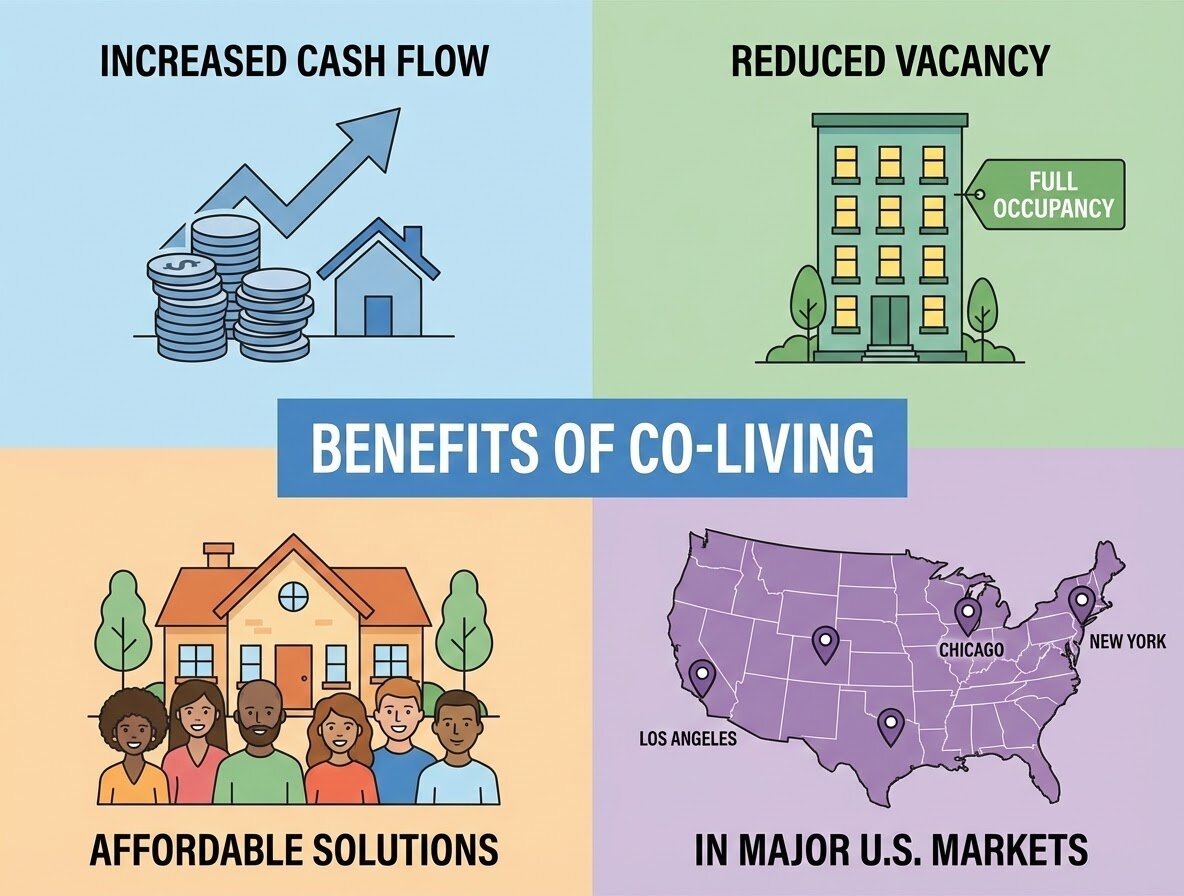
"Usually what we are helping people with is two major problems. There’s other stuff we help with, but when an investor comes to us, the solution they’re looking for is a solution to their cash flow problem or their vacancy problem. They’re like, ‘Hey, I have this three bedroom house. It’s not able — I just can’t rent it for whatever reason.’ So even renting it out in three rooms, maybe if only two rooms fill, at least they’re generating something rather than sitting vacant all year."
Devon was blunt about it: when an investor calls PadSplit, they’re almost always dealing with one of two problems.
Problem #1: Vacancy. A three or four-bedroom house sitting empty month after month, bleeding money in mortgage payments, insurance, and maintenance, with zero revenue coming in.
Problem #2: Cash Flow. The property is rented, but the numbers barely work. In today’s market, a traditional long-term rental on a three or four-bedroom house often returns $50 a month—or worse, loses money.
PadSplit’s rent-by-the-room model attacks both problems simultaneously. Even if only two out of four rooms are filled, the host is generating revenue instead of watching the property sit empty. And when you add extra bedrooms by converting common spaces, the cash flow multiplier kicks in hard.
How Hosts Increase Cash Flow by Adding Bedrooms
This is where the conversation got exciting. Devon’s advice to new hosts isn’t just “rent out each room.” It’s “convert your living room, den, or office into additional bedrooms—then rent those out too.”
"Not only renting out each room in a property, but adding extra rooms through converting extra common areas like living rooms, dens, offices, turning those into extra bedrooms. What that does is it helps mitigate some social conflicts. Having a couch and a TV in a living room doesn’t really build a sense of community. People think it would, but people tend to fight over the TV… So what we recommend is putting up walls, turning those into extra bedrooms."
"If you’re able to rent out, say, like a four-bedroom house for $4,000 a month… and our average in LA right now is about $1,200 a month per room… that brings you to about $4,800 in gross income. But if you’re able to add a fifth room… now you’re looking at $6,000 a month in gross revenue. Say you’re able to add a sixth bedroom, now you’re at $7,200 a month, and now you’re doing well."
"Majority of the time, if they’re doing it right, they can usually expect two times the cash flow at minimum. Sometimes they even see three times."
"When I first started with PadSplit, I was like, is anybody really even going to rent these rooms? This sounds crazy. But then you really dive deep and you realize — the people that are looking for more affordable housing options — you don’t realize how many of them there are. The demand is huge. Staggering."
"We usually recommend 2,000 square feet plus at least. The more convertible square feet, the better. You want at least two bathrooms to start because you can’t have more than four bedrooms using one bathroom. But we recommend a three-to-one ratio or lower, if possible."
"There are a lot of cities right now putting in rules saying co-living is okay. For too many years, we've been trying to say we'll have the city build affordable housing, and that's just not working. This is a private solution to a public problem. No taxpayer dollars needed."
"If you send somebody to us and they list at least four rooms for at least 90 days, we pay you a $1,000 referral bonus. Most people just haven’t heard of us yet. So a warm introduction works way better than Facebook ads."
"On my monthly webinar, I’ll find a property that works for PadSplit and I’ll do it live on the call. I talk more in depth on the operational side and what it takes to operate one."
Frequently Asked Questions About PadSplit Co-Living
1. What is PadSplit, and how does it work?
PadSplit is an online platform that connects property owners (hosts) with tenants (members) seeking affordable shared housing. Hosts furnish individual rooms, and PadSplit handles member acquisition, weekly payment collection, and listing distribution.
2. How much cash flow can you make with PadSplit?
Investors doing it right typically see at least 2x the cash flow compared to a traditional long-term rental. Properties with 5–7 rooms can see significantly higher returns depending on the market and pricing.
3. How does co-living reduce vacancy?
Each room is rented individually, so one vacancy doesn’t wipe out all revenue. With six rooms, losing one tenant still leaves five income-producing units—far less risk than an entire house sitting empty.
4. What is the average stay in a PadSplit?
The current platform average is about 8.5 months, though well-managed properties see much longer stays. One property manager with 1,100 doors reported an average stay of roughly 500 days (about 1.5 years).
5. What types of tenants rent rooms?
Members include service workers, senior citizens on fixed incomes, young professionals seeking affordability, and people who want to live closer to their workplace.
6. How many bathrooms do you need?
PadSplit requires a maximum of four bedrooms per bathroom, but a 3:1 ratio or lower is recommended. Starting with at least two bathrooms gives hosts more conversion flexibility.
7. Is co-living legal?
Yes. PadSplit structures stays as 31-day minimum commitments to differentiate from short-term rentals. The company also advocates with cities and states for supportive co-living regulations.
8. Is co-living better than Airbnb?
They serve different purposes. Co-living provides stable, long-term housing for local workers, avoids short-term rental bans, and faces less public backlash. Many investors are shifting to co-living as short-term rental regulations tighten.
9. What markets does PadSplit operate in?
PadSplit operates in nearly 30 core U.S. markets, including Atlanta, Charlotte, Dallas, Houston, Austin, LA, and Las Vegas—with the ability to support hosts in all 50 states.
10. How do you convert a house into a co-living property?
Most hosts convert common areas (living rooms, dens, offices) into furnished bedrooms. Budget-friendly conversions—like putting up a wall in a living room—can run under $5,000. Adding bathrooms costs more due to plumbing and permitting.
Apply to Be a Guest on the Make Yourself at Home Podcast
Real estate is evolving. Housing models are shifting. Markets are tightening. If you’re working in real estate and solving real problems, Make Yourself at Home wants to hear from you. Explore the Icons of Real Estate Podcast Network — then apply.
This podcast is produced by the Icons of Real Estate — #1 Real Estate Podcast Network.