
Creative financing is showing up in more conversations than ever. Sellers with sub-5% interest rates are fielding offers from investors they have never met. Buyers are pursuing strategies without fully understanding the risks. And agents are caught in the middle, trying to explain deals that most real estate training programs never covered.
That is exactly why I brought Caleb Christopher of Creative TC and DOS Guard onto Make Yourself at Home. He is a creative financing real estate specialist featured in Pace Morby's BiggerPockets book Wealth Without Cash by Pace Morby, and he built Creative TC and DOS Guard to make creative transactions safer, legal, and ethical - without cutting corners.
Here is what this episode covers:
-
What creative finance actually is, and the specific situations where it makes sense
-
The difference between a well-structured deal and a dangerous one
-
How due on sale clause risk works and what can be done about it
-
The communication systems Caleb uses to run a fully remote global team
-
What questions agents and sellers should be asking before accepting any creative offer
Listen to the full conversation here:
Caleb Christopher of Creative TC and DOS Guard: Why I Had This Conversation
I have been in real estate since 2008. I sat at more than three dozen kitchen tables with families navigating mortgages they could no longer afford. I watched deals collapse, foreclosures happen, and equity disappear. So when creative finance started gaining real traction in my market, I paid very close attention.
Homeowners across the Carolinas with low-rate loans are getting approached with offers they barely understand. Many agents did not have the language to explain what was really happening, or how to protect their clients. Understanding the risks before stepping into these transactions became something I felt I owed my clients.
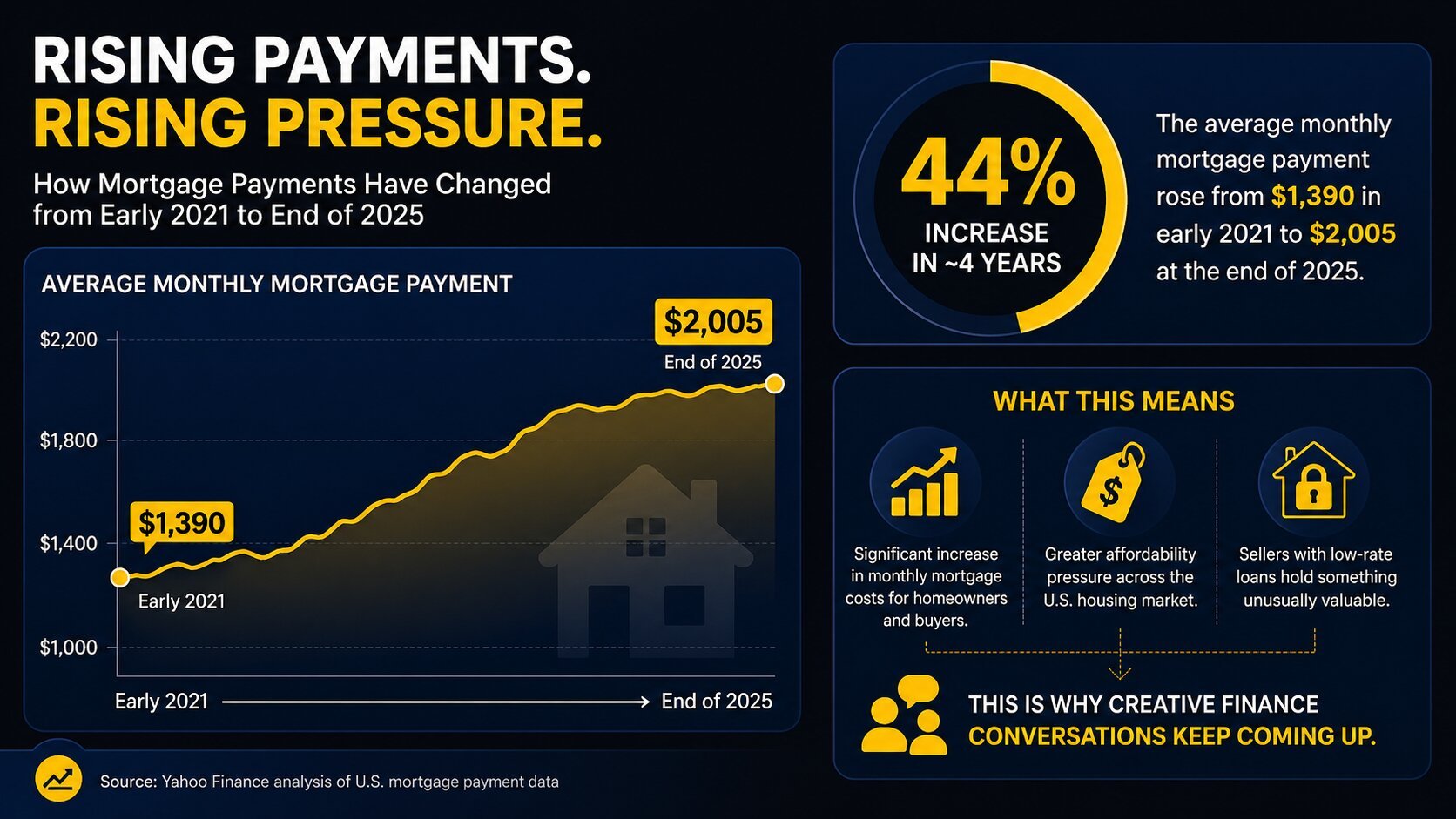
According to Yahoo Finance's analysis of how rising mortgage payments affect U.S. housing affordability, the average monthly mortgage payment rose from $1,390 in early 2021 to $2,005 at the end of 2025, a 44% increase in roughly four years. That kind of affordability pressure is exactly why sellers holding low-rate loans suddenly have something unusually valuable, and why creative finance conversations keep coming up.
Caleb Christopher of Creative TC and DOS Guard was the right person to bring in. He built his companies specifically because he saw the gaps in how these transactions were being handled, and he has spent years closing those gaps.
Creative Finance Is a Specialty Tool, Not a Magic Shortcut
One of the clearest things Caleb said on Make Yourself at Home was that creative finance is not for everyone. That pushes back against a lot of what people are hearing about subject-to real estate investing on social media. But his point was precise, and it is the thing people miss most.
"Creative finance is like a specialty tool. There's only specific tasks you need to do with it. But if you walk around with only a hammer in your hand, everything starts looking like a nail. People get this faddish obsession with creative finance just because they want to have done a creative finance deal, buying subject to somebody else's mortgage, or buying on seller finance. Creative finance is a specialty tool used in specific situations. It's not for everybody."– Caleb Christopher, Founder of Creative TC, DOS Guard, and Creative Title Company and DOS Guard
The clearest example Caleb gave was a veteran who bought a home with a VA loan, received orders to move six months later, and was staring at a $30,000 out-of-pocket loss just to sell. An investor offering to take over the loan while covering moving expenses turned that $30,000 loss into a $40,000 net gain. That is the scenario creative finance is built for.

For sellers with little equity, the math on a traditional sale can be brutal. According to Zillow's research on typical seller closing costs in the United States, seller closing costs have historically ranged from 8% to 10% of the home's sale price, which on a typical $362,000 U.S. home can mean $28,960 to $36,200 in out-of-pocket expenses at closing.
Here is a quick reference for when creative finance makes sense and when it probably does not:
|
Creative Finance Is a Fit When… |
It Probably Is Not a Fit When… |
|
Seller has little or no equity to cash out |
Seller has significant equity and can sell traditionally |
|
Seller has a low interest rate worth preserving |
Current rates are comparable to the existing loan |
|
Traditional sale would result in a loss at closing |
Seller wants a clean transfer with no ongoing credit ties |
|
Buyer is an experienced investor with documented reserves |
Buyer is a first-time consumer with no financial cushion |
If you are not sure which column fits your situation, Caleb's advice is to get into creative finance Facebook groups, read the threads, and honestly assess whether you are willing to carry the risks other people are dealing with. That reality check comes before anything else.
What Makes a Creative Finance Deal Ethical, and What Does Not
This is where Caleb's background in seller finance deal structuring and risk management showed up most clearly. When he looks at a creative real estate transaction, he diagrams it like a network: map the parties, find the obligations, and locate every point where things can break down.
"It's cool to do a deal with zero dollars out of pocket. Very cool to do a deal. It is unethical to do a deal with zero dollars in your pocket. I'm looking for somebody who not only has the cash to close, but who can demonstrate that they have the cash to maintain even after closing. The ethical person is going to promise to make your payments, even if they don't have a tenant, even if they can't find a buyer for the property. That's what I've done."– Caleb Christopher, Founder of Creative TC, DOS Guard, and Creative Title Company
On his Pueblo, Colorado deal, the property sat vacant for months. He made every single payment. The seller's credit never took a hit. That is the standard he holds himself and his clients to.
The other major risk in creative deals is due on sale clause protection. Banks technically have the right to demand full repayment when they discover someone else has taken over the property. It does not happen constantly, but the risk never fully goes away.
"The due on sale clause allows a bank to accelerate the loan. If I bought your house subject to the loan and I'm making your payments, even if everything's good between us, the bank, if they notice and if they care, can say 'pay us off' with 30 days. And that never goes away in a sub-two deal. You've got to be able to handle that risk."– Caleb Christopher, Founder of Creative TC, DOS Guard, and Creative Title Company
That is exactly why Caleb built DOS Guard. Specialists on staff navigate those conversations with banks before they escalate. It does not eliminate the risk entirely, but it dramatically reduces it when all parties stay cooperative.
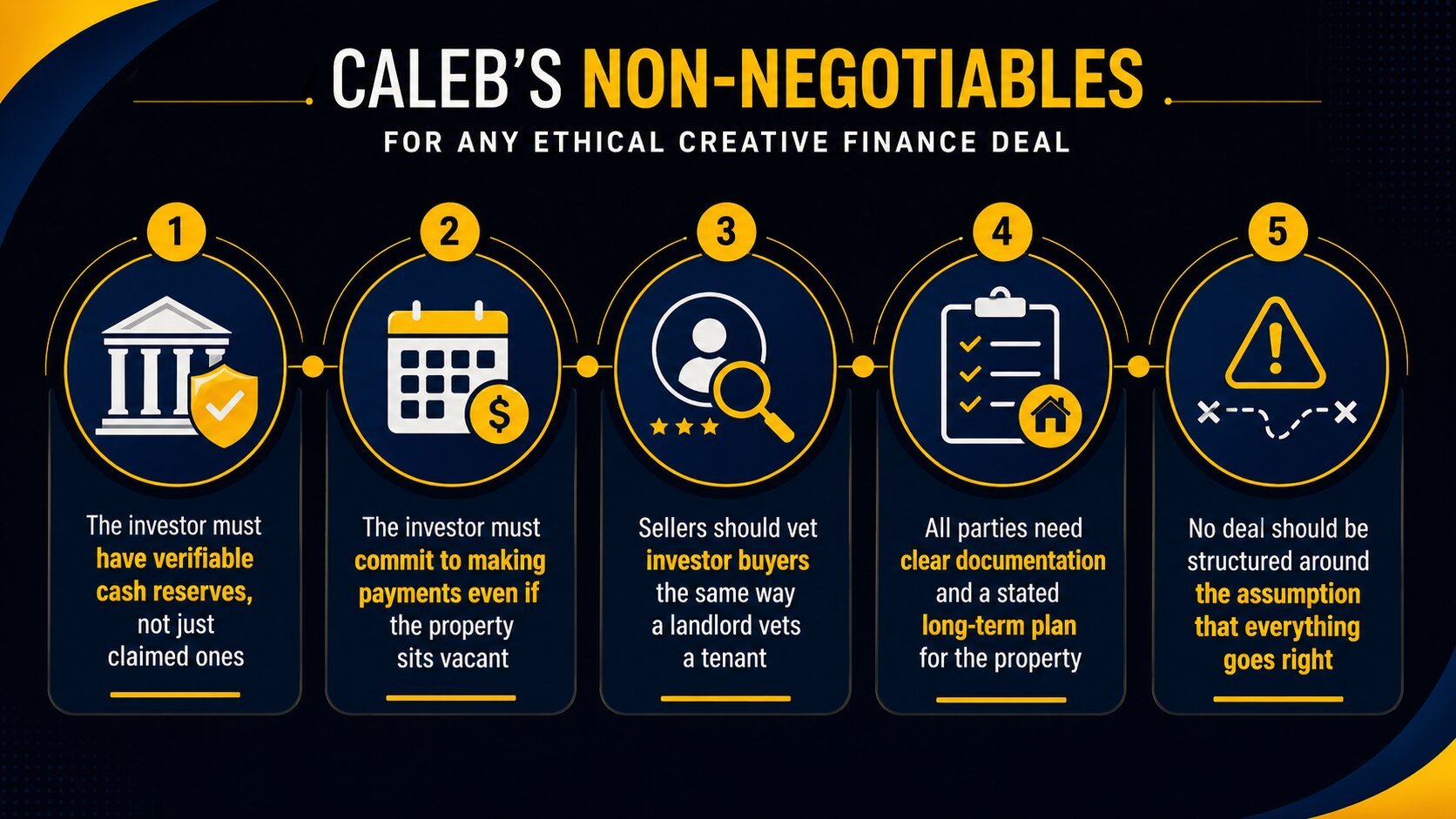
Here are the non-negotiables Caleb laid out for any ethical creative finance deal:
-
The investor must have verifiable cash reserves, not just claimed ones
-
The investor must commit to making payments even if the property sits vacant
-
Sellers should vet investor buyers the same way a landlord vets a tenant
-
All parties need clear documentation and a stated long-term plan for the property
-
No deal should be structured around the assumption that everything goes right
How Caleb Built a Remote Team That Actually Works
What I did not expect in this conversation was how much of it would center on communication and team structure. It turned out to be one of the most practical sections of the episode for anyone running a real estate business.
Caleb's company runs 100% on Zoom with a global team based primarily in South Africa. He chose this deliberately. The level of education and alignment with core values he needed simply was not affordable at U.S. market rates. His team members are college-educated, experienced, and trained on specific frameworks that keep every transaction moving cleanly.

Two communication tools stood out:
BLUF: Bottom Line Up Front. Write your email however you normally would, then cut the main point from the bottom and paste it at the top. The reader sees exactly what is needed the moment they open the message. No scrolling, no hunting.
WITNSS: What Is The Next Step. At the end of every message, state who owns the next action and by when. No ambiguity, no separate follow-up needed just to figure out what comes next.
His core values system, SCORE, follows the same precision. Each value pairs a context statement with a clear directive:
|
Value |
Context |
Directive |
|
Speed |
Time kills all deals. |
Act with urgency. |
|
Care |
Deals involve real people. |
Act accordingly. |
|
Objectivity |
Pressure distorts judgment. |
Decide with facts. |
|
Resourcefulness |
Obstacles are a given. |
Find a way to get it done. |
|
Excellence |
Average is not good enough. |
Set the standard. |
These are operational values, not aspirational ones. Caleb uses them to hire, evaluate, and hold his team accountable every single day.
What Changed for Me After This Conversation
"If you can name it, I've probably done it. It's pretty unlikely that I haven't touched whatever deal type is in your head. I walked into my Pueblo, Colorado deal because there was no equity. It hadn't sold on the market for six months. I showed them my credit score and an example of a rental that didn't pay for six months. I never missed my payment. I will not miss your payment. And ever since, their credit is good because of me."– Caleb Christopher, Founder of Creative TC, DOS Guard, and Creative Title Company and DOS Guard
I have been cautious about creative finance deals because I know how much damage a poorly structured one can do. What this conversation gave me was not just caution but a framework. Now, when a creative offer comes across my desk, I know exactly what to ask: What are the reserves? What happens if the property sits vacant for three months? Can you show documentation from previous deals?
If you are a seller with equity who wants to understand your options before fielding any kind of offer, start with a free home valuation in Charlotte to see where you stand. If you want to explore what is currently available through traditional channels, the listings in Charlotte metro area, North Carolina and Properties in Charlotte metro area, North Carolina are a solid place to start.
Frequently Asked Questions About Caleb Christopher, Creative TC, and DOS Guard
Who Is Caleb Christopher and What Does Creative TC Do?
Caleb Christopher is the founder of Creative TC, a creative transaction consulting firm, and DOS Guard, a service that helps buyers and sellers navigate due on sale clause protection in subject-to transactions. He was featured in Pace Morby's BiggerPockets book Wealth Without Cash and has a background in law enforcement, cybersecurity, and risk management.
What Is Creative Financing in Real Estate and When Does It Make Sense?
Creative financing refers to strategies that do not rely on traditional bank loans, most commonly subject-to real estate investing (where a buyer takes over an existing mortgage) and seller finance deal structuring (where the seller acts as the lender). It works best when a seller has little equity, a low interest rate worth preserving, or would lose money in a traditional sale. It is not a universal strategy and works best in specific scenarios with the right parties involved.
How Can a Seller Protect Themselves in a Creative Finance Deal?
Sellers should treat an investor buyer the same way a landlord treats a rental applicant. Verify financials, check references, and ask for documentation of past deals. A trustworthy investor will have cash reserves and a track record, and will not hesitate to show proof. Any investor who refuses to demonstrate financial capacity should not be at the table.
Keep the Conversation Going
If you want safer, legal, and ethical creative finance real estate deals, reach out to Caleb Christopher of Creative TC and DOS Guard directly:
-
Website → https://calebchristopher.io/
-
LinkedIn → https://www.linkedin.com/in/calebchristopher
-
Facebook → https://www.facebook.com/FCalebChristopher/
-
Instagram → https://www.instagram.com/fcalebchristopher/
If something in this episode made you think, question, or laugh, don't let it stop here.
Follow "Make Yourself at Home" and stay part of the conversation:
🎧 Follow Deana Brummett:
-
🌍 Website → https://athomeinthecarolinas.com/
-
📷 Instagram → https://www.instagram.com/AtHomeintheCarolinas/
-
📘 Facebook → https://www.facebook.com/HomeintheCarolinas
Apply to Be a Guest on "Make Yourself at Home" Podcast
If you serve the real estate industry - through staffing, lending, brokerage, technology, or advisory - and help agents grow smarter, not harder…
Let's spotlight your insights.