Real wealth is built over years, not overnight. That was the message from my conversation with Lauren Rogers of Veritas Equity Partners, a Pacific Northwest private equity real estate firm, on Make Yourself at Home. She explained how one partner's $250,000 grew into $6 million of equity over 12 years, why "no money down" loan hype disappoints everyday investors, and why starting small with a syndicator can beat buying a duplex alone.Curious about this episode? Watch the preview here.
Quick takeaway: Start small, learn first, and stay patient. Real estate rewards years of steady work, not shortcuts.
How $250,000 Became $6 Million in Equity Over 12 Years
Lauren Rogers, partner at Veritas Equity Partners, told me the firm was built on personal capital. Her partner, Alex, put $250,000 into an eight-unit building in Seattle when he was 20. He had been curious about wealth since childhood, and nearly every wealthy person he asked said they made money in real estate, often in multifamily.
Lauren and Alex both spent more than a decade in tech sales at Amazon and startups. She came to Alex asking for help underwriting a duplex. It became an accidental business partnership.
"Real estate's one of those funny things. It starts out as very little and it feels like it's not making any impact at all, which is something that I think people need to understand. You hear a lot of stories, and it kind of seems like people were able to retire overnight. That's not true. It took Alex 12 years in a very hot cycle, and he was aggressively wanting that money to eventually have $6 million of equity. He owns $13 million worth of buildings throughout Washington state."
Alex says he did not realize how much he had until a lender called about a refinance that could pull out $3 million. What he did see was strong cash flow.
Looking back, they wish they had raised outside capital sooner. Lauren also said wealth managers may not recommend this path because they would not get paid on it.
Why Multifamily Investing Builds Cash Flow With Less Risk
Lauren calls C and B class buildings about as bulletproof as it gets. For multifamily investing, her investors target a 20 percent IRR or higher. She is not an industrial or office expert, so she shared what experienced investors told her:
Asset Type | Lauren's Take |
|---|---|
Industrial, storage, office | Stable, but lower returns |
C and B class multifamily | Conservative, with room for an unexpected bigger return |
Multifamily development | Potentially very large returns, or you lose all your money |
In Seattle, rents keep going up. The area is expensive, there is not enough land, and building is hard. Vacancies may rise at times, but the buildings keep cash flowing.
I added my own view as an agent. Home values in my market rise about 3 to 7 percent a year on average. We saw 10 to 20 percent jumps in 2019 through 2022, and this year is a slow crawl.
The DSCR Loan Myth: Why "No Money Down" Disappoints Everyday Investors
One buzzword frustrates me. People hear that a DSCR loan lets you buy a house with nothing out of pocket. Seminars pack a hundred people into a hotel conference room and promise that anyone can do it.
Then these buyers walk into a bank. In my experience, they are told to bring 25 percent to the table. They are shocked, because they were told it was free. I live in a state built on furniture, socks, and hosiery. These are people who worked in factories their whole lives. They deserve honest information.
Real Estate Professional Status, Depreciation, and 1031 Exchanges
Lauren shared three tax ideas, with the caution that they do not apply to everyone:
Real estate professional status. A high earner can offset taxes, especially in a household with one main earner.
Depreciation. She says investor distributions often are not taxed because depreciation exceeds what is needed.
1031 exchange. After an exit, investors can roll the proceeds into another deal.
"If you have a high-earning spouse, then I would recommend the lower earner, unless of course they love their job and they're really passionate about it. This was my initial plan. As a very high earner, I was able to essentially replace my entire tech salary in tax savings by becoming a real estate professional. What we would pay a year in taxes would basically equal out. And this doesn't apply to everyone, I get that. But I also know a lot of people that if one person stays at home or is a homemaker, you can utilize that real estate professional status."
Why Start With a Syndicator Instead of a Duplex
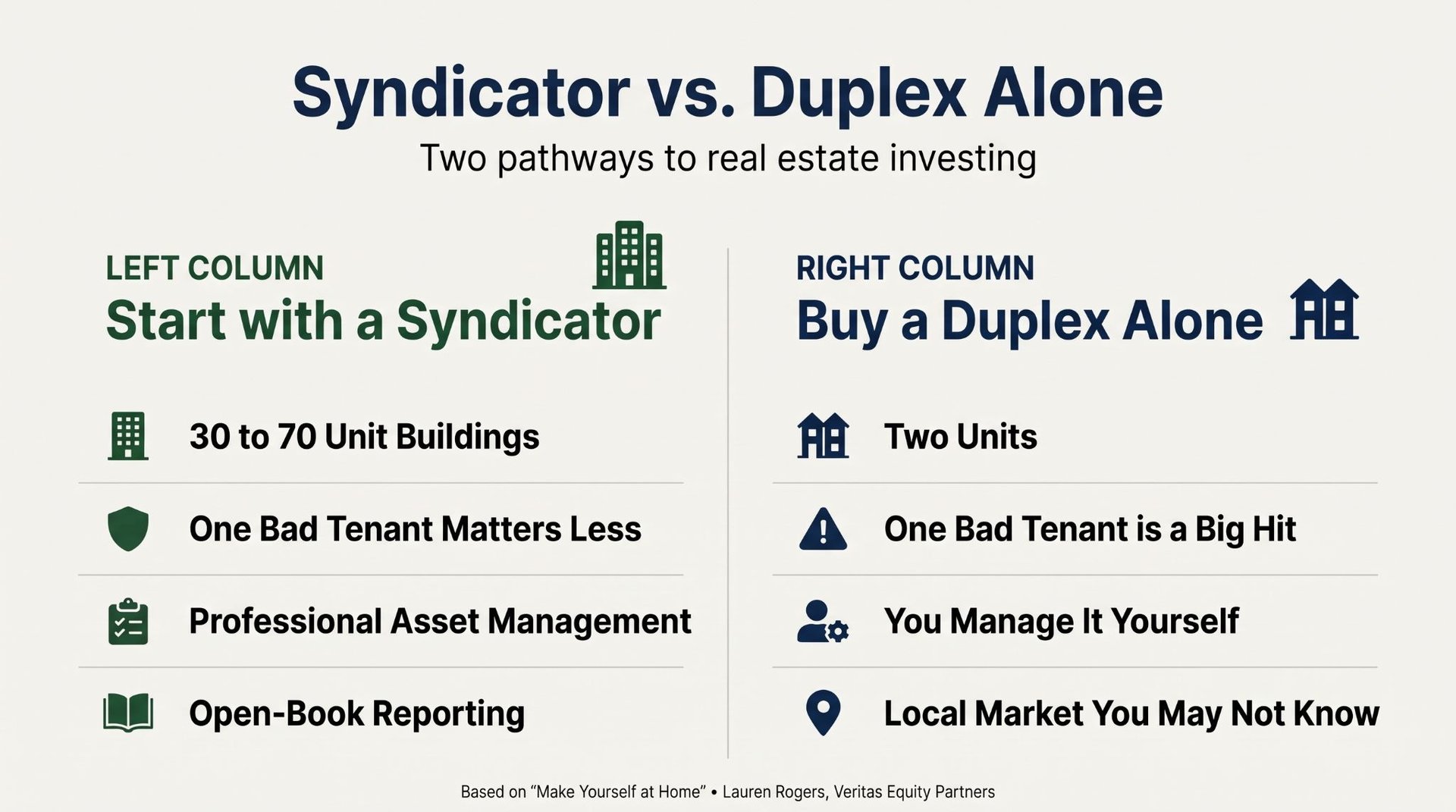
Veritas Equity Partners partner Lauren Rogers supports starting with real estate syndication. She buys buildings with 30 to 70 units, so one bad tenant barely moves the business. She also invests only about 30 minutes from home because real estate is hyper-local.
She stays hands-on. Even with property managers, she spends four to five hours a day as an asset manager catching errors. That is a lot of work for a small owner.
"Starting out with a syndicator is a very wise decision. Now, I'm not opposed to people doing it on their own, but I have a lot of clients that have lost their socks that way. They come to me and say, I bought this duplex. It's a mess. I have a tenant that I couldn't get out for six months. I only buy buildings that have 30, 40, 50, 60, 70 units, so when I can't get one tenant out, it really doesn't affect my business that much. If you're renting a single family home, that's a huge problem. I think a better way to do it is to start with a little bit of money that you can afford with a syndicator that you trust and learn from them."
She offered an example. She started by putting $50,000 with Alex to learn how it worked. Her team sends thorough reporting and stays open book.
Why the Washington Multifamily Market Is Underrated
Lauren has invested in greater Seattle for about 16 years. In her view, the Washington multifamily market stands out for several reasons:
A diverse economy. It goes beyond tech to Boeing, Costco, Starbucks, healthcare, military bases, and logistics.
A housing shortage. There is not enough workforce housing, and land is scarce.
Plenty of deals. Snohomish County alone has more than 2,000 buildings of 20 to 100 units that fit her criteria.
Motivated sellers. Some owners inherited buildings they do not want, and others are retiring.
Rent control is part of the picture. Lauren says Washington's cap is almost 10 percent, which is very high, and Veritas underwrote it before it passed. Holds run five to seven years. Rules vary by county, and Snohomish is moderate. Her tenants are working people who stay for years, since the average home costs about a million dollars.
Her closing thought stuck with me: if people get scared to buy somewhere, that is an advantage.
How Business Partners Who Became a Couple Divide Roles
Lauren and Alex were business partners for eight months before they became a couple. They are getting married in August. She started in investor relations. Now Alex handles debt, acquisitions, and investors. Lauren runs asset management, plans investor events, and compiles reporting.
Clear lanes help. They already knew they ran a business well together, so there is little friction.
Frequently Asked Questions About Multifamily Investing
Should I grow with personal capital or raise outside investors?
Raise sooner than you think. Veritas grew on its partners' own money and now says it should have raised outside capital earlier.
Is multifamily a better investment than the stock market?
Lauren says it can target higher returns at lower risk. She calls C and B class multifamily a conservative route to a 20 percent IRR.
Why is Washington State strong for multifamily investing?
She cites a diverse economy and little buildable land, plus a workforce housing shortage.
Does rent control make Washington multifamily harder to underwrite?
Not if you model it in. Veritas underwrote the cap before it passed.
Connect With Lauren Rogers and Deana Brummett
VisitVeritas Equity Partners or find Lauren onLinkedIn. For more Carolinas real estate conversations, visitmy website, or follow me onInstagram,Facebook, andLinkedIn. Thank you to Lauren Rogers of Veritas Equity Partners for a patient, honest take on building wealth.
Apply to Be a Guest on the Make Yourself at Home Podcast
Everyone deserves to feel at home. If you work in real estate, lending, or investing and want to educate buyers, sellers, and investors, I'd love to hear from you.
This podcast is produced by the Icons of Real Estate - #1 Real Estate Podcast Network. If you are a real estate professional, apply to be a guest speaker across the network.